Showing posts with label Lincoln. Show all posts

Tuesday, August 10, 2010

10 Greenest Presidents

It was only a matter of time before a list like this surfaced. Many administrations did excellent work in promoting environmental and sustainable causes. These are the 10 best.

  1. Teddy Roosevelt - Comes as no surprise... He's the original Environmentalist
  2. Jimmy Carter - he was always more of a humanitarian than an executive anyway...
  3. Thomas Jefferson - Louisiana Purchase and Lewis and Clarke did a lot for his ranking.
  4. Bill Clinton - With Gore over his shoulder, you'd expect some change...
  5. Richard Nixon - he made the list of Presidents with the worst environmental record too...
  6. Franklin Roosevelt - Civilian Conservation Corps... part of the New Deal
  7. Abraham Lincoln - established the US Department of Agriculture (USDA)
  8. Lyndon Johnson - protected 9 million acres of land with the Wilderness Act
  9. Woodrow Wilson - oversaw the creation of the National Park Service... (Teddy's idea...)
  10. John Kennedy - had his guys look into the effect of pesticides and chemicals... laying groundwork for the EPA.

To read more about each President and their contributions go to the Daily Green
http://www.thedailygreen.com/environmental-news/latest/greenest-presidents-460808 - You can also see a list of the Presidents with the worst environmental policy...

Read More...

Wednesday, April 07, 2010

US Presidents Race

Those that have been reading this blog know that I'm a baseball fan. Much more than a baseball fan, I've been a die-hard Phillies' fan my entire life. As a kid I had some very lean years in the mid-80s. Lately, as you may well know, the Phillies have made up for many of those last place finishes. The city has really embraced this team.

Tonight the Phillies are playing the Washington Nationals.

I think it's worth mentioning that the Nationals have a pretty cool tradition at their home games that has great historical significance.

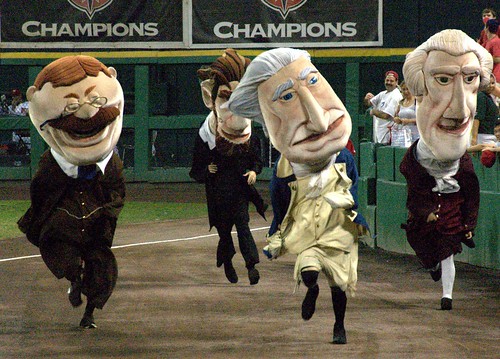
Much like a minor league baseball stunt, to keep the fans entertained between innings, there is a Presidential race. Only this race involves four mascots representing the four presidents on Mount Rushmore.

Every game, George Washington, Thomas Jefferson, Abraham Lincoln and Teddy Roosevelt compete. The race originated as a scoreboard graphic, but has morphed into the "live-action" race pictured above.

There is a running joke that Teddy Roosevelt never wins. He'll often become distracted, or become disqualified for numerous reasons.

For more information about the race, you can read more at wikipedia: http://en.wikipedia.org/wiki/Presidents_Race

By the way, the Phillies are currently winning 6-3 in the 7th.

Read More...

Monday, February 08, 2010

John Muir - Library of America's Story of the Week

I like books. I like collecting books and referencing books and knowing that I have books that could cover almost every part of American history. But like most of the free world, I don't like to pay for books. To subscribe to the books that Library of America (LOA) offers, one has to pay a heft price.

LOA usually has some kind of introductory offer that is too good to pass up. I acquired 3 books this way. I was browsing my own web site, http://USHistorySite.com and saw an add for an Abraham Lincoln collection for about $5, and a free book about US Grant. I clicked on the add (even though it was on my own site... sorry GoogleAds, I probably have 3 fraudulent cents in my pocket), and I got the books and quickly sent back the invoice with 'cancel' on it... Of course I still received a shipment of books, paid for them to be returned and made a phone call to cancel my account. I didn't like the idea of paying monthly for more books. But I do have some pretty good looking cloth bound books about Lincoln now in my collection.

And another good thing about giving them my information is now I receive The Library of America Story of the Week via email. This is simply a link to a blog written by an LOA staffer which gives their service more exposure and allows you short previews of the books the peddle.

The story I received last week struck a chord... John Muir. I'll be honest, I hadn't hear of John Muir until a few years back when my wife and I were visiting family in San Francisco on the way back from our honeymoon. We were fortunate to be able to spend a few hours driving Muir Woods just north of San Francisco. Naturally the curiosity in me nudged me to research a little more about Muir. That year while teaching in Atlanta the high school librarians were getting rid of old books that hadn't been checked out in a few years - and I was able to convince my wife to allow a box load or two to come back to our 2 bedroom apartment in Atlanta. One of those two boxes of books was a collection of John Muir writings, with a narrative by a more modern writer of the same vein.

To make what's already a rather long post shorter... John Muir is founder of the Sierra Club and a catalyst for the preservation of Yosemite National Park. Library of America pays tribute to the best thing since Thoreau in their blog: http://www.loa.org/storyoftheweek/2010/01/wind-storm-in-forests.html

Enjoy his prose. And then go outside...

Read More...

Friday, November 06, 2009

Gettysburg: One Man's Visit

I don't know about the rest of you, but I'm an excitable reader. By this, I mean that I get excited about reading, and usually try to bite off more than I can chew. But this is never a bad thing.

When it comes to books, I have a problem. I rarely finish them. This is probably due to my excitability around books and the subjects they cover. I'll read 90% and gladly pick up another if the mood suits me. I'll read 4, 5, 6 books at one time. And as a dedicated teacher and father it is hard to find time to sit back and relax with a good book.

This weekend is no different. I'm going to Gettysburg, and I'm excited about a few books.

For my birthday my wife has decided to take me to Gettysburg this weekend. A short drive from our home in Philadelphia, Gettysburg is one of those places that has always eluded me. So I'm excited to finally get the opportunity to go. And we're not just going. We're GOING. We're leaving tonight (Friday) and staying all day Saturday and some of the day Sunday.

In preparation, and for the little downtown I'll have (with bringing our 3 1/2 month old son with us), I've brought with me, two books. One I've already read; The Killer Angels, by Michael Shaara
. It's a favorite of mine, and because of the way it's written, it's a book I've finished. I hope to thumb through this and pull out some good dialogue concerning the battle.

The other book I've brought with me is a collection of speeches and writings of Abraham Lincoln
. This book, from the Library of America collection is a cool looking canvas bound book, which looks great on a book shelf. (a book shelf that doesn't exist in my house)

These books, along with the history of Gettysburg, the nightly ghost tours, the quaint little town of Gettysburg and my incredible wife and son, are sure to make my birthday weekend enjoyable. Oh, and an Eagles win over the Cowboys Sunday night would help too. All of this might make the Phillies loss a little easier to swallow.

Happy Reading!

Go Birds!


Read More...

Wednesday, May 20, 2009

Favorite American Quote Winner

Several weeks ago I asked my readers to contribute their favorite quote from American history. I promised I'd choose my favorite from the list and highlight it in a future post. This... is that future post.


I'd first like to thank those of you that contributed. We had about ten participants and about 15 submissions.

My favorite of the bunch was from the anonymous contributor 'boldlygo', who submitted a great Abraham Lincoln quote from a letter Lincoln wrote to Union General George McClellan.

"If you don't want to use the army, I should like to borrow it for a while."


That said, here's a little history of that quote...

Lincoln, was known as a micro-manager. During the war he could hardly keep still and was constantly getting his hands dirty in the details of the war. According to Doris Kearns Goodwin, Author of Team of Rivals: The Political Genius of Lincoln, Lincoln would often "get himself to the battlefield to visit the soldiers, walk amidst their ranks, [and] see the wounded in the hospital."Abraham Lincoln would often walk amongst the soldiers during the Civil War

The picture to the left is a great example of Lincoln's "Management by Walking Around" concept. A strategy still used today by many managers and supervisors.

His relationship with McClellan was no exception. McClellan was entrusted with the duties of leading the Union soldiers to battle against the Confederates. McClellan however, who's talent was in organization and training, did little more than prepare his soldiers for battle. Lincoln repeatedly urged his General to "engage the enemy" but McClellan claimed he needed more men, more munitions and more time. And with Lincoln's aforementioned want of total control Lincoln asked for control of the Army of the Potomac in March of 1862.

Lincoln wanted to win the war quickly, and was no longer willing to accept McClellan’s belief that the Union Army "should take their time and use extra precaution". An interview found in Spartacus, in March of 1863, Lincoln said:

I directed McClellan peremptorily to move on Richmond. It was eleven days before he crossed his first man over the Potomac; it was eleven days after that before he crossed the last man. Thus he was twenty-two days in passing the river at a much easier and more practicable ford than that where Lee crossed his entire army between dark one night and daylight the next morning. That was the last grain of sand which broke the camel’s back. I relieved McClellan at once.

Lincoln soon replaced McClellan with Ambrose Burnside. Lincoln would go on to relieve several more Union leaders until finally settling on Ulysses S. Grant to finish the war.


Other Works cited:

http://www.pabook.libraries.psu.edu/palitmap/bios/McClellan__George_B.html

http://books.google.com/books?id=qbefJcN89sIC&printsec=frontcover

Team of Rivals: The Political Genius of Lincoln by Doris Kearns Goodwin

Read More...

Wednesday, April 15, 2009

On This Day: April 15, 1861 - Civil War Begins

The following post was submitted by USHistoryBlog contributor Tom Haynes.

On this day, the Civil War officially began. In response to southern forces firing on Fort Sumter three days prior, President Abraham Lincoln declares a state of insurrection and calls out Union troops.

In the resolution issued this day, Lincoln called 75,000 militia troops from the various states still loyal. At this point, seven states had announced their intention to secede from that Union. South Carolina had been first, followed by Mississippi, Florida, Alabama, Georgia, Louisiana, and Texas. The militia's first duty, according to Lincoln's statement, would be to secure federal property seized by those states.

At the same time, Lincoln called both houses of Congress into session, scheduled for the 4th of July 1861. This period would be something of a lull in hostilities, but several more states (most notably Virginia) would quickly respond to Lincoln's call for troops by joining the secession movement.


Whereas the laws of the United States have been for some time past, and now are opposed, and the execution thereof obstructed, in the States of South Carolina, Georgia, Alabama, Florida, Mississippi, Louisiana and Texas, by combinations too powerful to be suppressed by the ordinary course of judicial proceedings, or by the powers vested in the Marshals by law.

Now therefore, I, Abraham Lincoln, President of the United States, in virtue of the
power in me vested by the Constitution, and the laws, have thought fit to call forth, and hereby do call forth, the militia of the several States of the Union, to the aggregate number of seventy-five thousand, in order to suppress said combinations, and to cause the laws to be duly executed. The details, for this object, will be immediately communicated to the State authorities through the War Department.

I appeal to all loyal citizens to favor, facilitate and aid this effort to maintain the honor, the integrity, and the existence of our National Union, and the perpetuity of popular government; and to redress wrongs already long enough endured.

I deem it proper to say that the first service assigned to the forces hereby called forth will probably be to re-possess the forts, places, and property which have been seized from the Union; and in every event, the utmost care will be observed, consistently with the objects aforesaid, to avoid any devastation, any destruction of, or interference with, property, or any disturbance of peaceful citizens in any part of the country.

And I hereby command the persons composing the combinations aforesaid to disperse, and retire peaceably to their respective abodes within twenty days
from this date. Deeming that the present condition of public affairs presents an extraordinary occasion, I do hereby, in virtue of the power in me vested by the Constitution, convene both Houses of Congress. Senators and Representatives are therefore summoned to assemble at their respective chambers, at 12 o'clock, noon, on Thursday, the fourth day of July, next, then and there to consider and determine, such measures, as, in their wisdom, the public safety, and interest may seem to demand.

In Witness Whereof I have hereunto set my hand, and caused the Seal of the United States to be affixed. Done at the city of Washington this fifteenth day of April in the year of our Lord One thousand, Eight hundred and Sixtyone, and of the Independence the United States the Eightyfifth.

ABRAHAM LINCOLN

By the President:
WILLIAM H. SEWARD, Secretary of State.


Read More...

Thursday, April 09, 2009

Links to History: Lincoln Assassination PBS Special

Received this information via email - thought some of my readers would enjoy it.

"Harold Holzer, co-chairman of the U.S. Lincoln Bicentennial Commission, appears with acclaimed actor Sam Waterston in a special performance edition of BILL MOYERS JOURNAL at 9 pm on Friday, April 10 -- which is also Good Friday, the tragic day of Lincoln’s assassination.

Lincoln’s Legacy and Legend is a deeply moving and intimate performance of poetry and prose written by Walt Whitman, Frederick Douglass, Allen Ginsburg, Langston Hughes, Harriet Beecher Stowe and many other American writers who have struggled to find words to describe perhaps the greatest of American heroes.

This special edition of BILL MOYERS JOURNAL is based on a private performance that Holzer and Waterston did in February at New York’s Century Club. “That was magnificent,” said Moyers, who was in attendance that evening. “This should be on television, and I intend to put it on.” And now he is doing exactly that.

More information and a press review preview clip are available in a web toolkit at this link: http://www.pbs.org/moyers/journal/lincoln/toolkit.html

The toolkit includes web banners and buttons as well as embeddable video clips of Sam Waterston’s performance that can be added to blogs, websites, facebook pages, etc. A program press release is attached to this email as a Word document for ease of use. The public can be referred to a preview here: http://www.pbs.org/moyers/journal/lincoln/watch.html.

After the premiere of Lincoln’s Legacy and Legend on PBS on April 10th, the program can be viewed online in its entirety at www.pbs.org/moyers/lincoln. The website will also include a robust collection of additional visual and educational material."

Read More...

Wednesday, February 11, 2009

Links to History: Lincoln's 200th Birthday

I receive great information via email and love to share them with you... This one comes from the Oxford University Press. In celebration of the Lincoln Bicentennial, the OUPblog is featuring a few posts from well known authors and Lincoln Historians:


* An excerpt from James McPherson's ABRAHAM LINCOLN:
http://blog.oup.com/2009/02/lincoln-mcpherson/

* A series of FAQs with Allen Guelzo author of LINCOLN: A Very Short Introduction:
http://blog.oup.com/2009/02/lincoln_questions/ and http://blog.oup.com/2009/02/abraham-lincoln-faq-part-one/


* A look at how Lincoln almost failed by Jennifer Weber author of COPPERHEADS: The Rise and Fall of Lincoln's Opponents in the North:
http://blog.oup.com/2009/02/lincoln_fail/

Not to be outdone, the Constitution Center, as always has Lincoln's Crossroads, an educational based game with an animated Lincoln. - http://constitutioncenter.org/lincoln/

Read More...

Saturday, February 07, 2009

Thinkin' You Know Lincoln? - Lincoln Lesson Plan Contest

abraham lincoln lesson plan contest primary source documentsIn honor of Lincoln's 200th Birthday on February 12th, the History Channel is sponsoring a Lincoln Lesson Plan Contest.

Teachers have until April 8, 2009 to submit a lesson plan to be judged on relevance to curriculum, clarity of expression, use of primary sources and innovative and/or multi-media strategies, and an explanation of the assessment method.

For more information about the Abraham Lincoln contest, click on the link below:http://www.history.com/content/give-a-lincoln/lincoln-contest-for-students-and-teachers

After clicking on the link, be sure to check out the teacher resources on the right side of the ensuing page. It's a collection of discussion questions and extension activities that go along with a video you can purchase from the History Channel, but in my experience, you can often find something similar for free in other places.

For more Abe Lincoln resources, check out some of the sources below:

Read More...

Saturday, January 31, 2009

Obama Follows in Lincoln's Footsteps

Most of us are familiar with President Obama wanting to take a train from Philadelphia, to his inauguration in Washington, D.C. Obama wanted to trace the route Lincoln took to his inauguration.

Obama's trip included a stop in Delaware to pick up Vice President-elect Joe Biden and a stop in Baltimore for a speech. But Lincoln was not originally scheduled to go to Delaware.

Lincoln was scheduled to make the trip from Springfield, east to Philadelphia to Harrisburg and finally from Harrisburg to Baltimore. But his trip did not go as planned.

So why did Lincoln make a stop in Philadelphia? And what happened that forced him to change his plans?

On February 11, 1861, Lincoln bid adieu to his supporters in Springfield, Illinois, and boarded a train east with an eventual destination of Washington. With several stops along the way, Lincoln finally arrived in Philadelphia on February 21.

Here is a link to one of his stops in Peekskill, NY, on February 19.
http://www.johngtesta.com/lincoln.html
The website belongs to the Mayor of Peekskill, John Testa and has some pretty cool information about Lincoln's stop there, and a statue dedication. Seems like a cool resource for Lincoln aficianados.

February 21st was George Washington's Birthday, and Lincoln was in Philadelphia to celebrate the event at Independence Hall. The night before arriving in Philadelphia, Lincoln's party was alerted to a plot to assassinate the President-elect by derailing the train from Harrisburg to Baltimore and killing Lincoln and everyone on board, or by attacking his carriage once he reached Baltimore.

Because of this, Lincoln decided to change his plans. He continued to Harrisburg as scheduled, but then decided to secretly return to Philadelphia to avoid the assassination attempt. All telegraph lines from Harrisburg were cut and guards were posted at various points along the train's route to ensure Lincoln's safety.

Once in Philadelphia, Lincoln transferred to a train in Wilmington, Delaware and then was once again secretly carried to Baltimore. He arrived in Washington on February 23, safely and in plenty of time before his March 4th inauguration.

Read More...

Wednesday, November 26, 2008

Mary Had a Little Lamb... for Thanksgiving.

Sara Hale, author of the famous poem, Mary Had a Little Lamb and one the nation's first woman magazine editors played an instrumental part in making Thanksgiving a national holiday.


Ms. Hale worked tirelessly writing letters to the Presidents because she thought it was a good idea to have a holiday where all Americans could collectively give thanks. Her passionate letters and essays finally caught up with Abraham Lincoln. With a nation divided Lincoln thought the idea was a good one and thus declared the last Thursday in November, as Thanksgiving.

But FDR would later try to move this date up, in an effort to boost the economy and get an extra week for holiday shopping. For one year, 1940, this caused much confusion, so much that America actually had two Thanksgivings that year. Some states recognized FDR's decree, while others still followed Lincoln's last Thursday declaration. Congress eventually agreed to make it the 4th Thursday of the month instead of the last Thursday. You can read about the whole story here.

The first Thanksgiving, the one celebrated in 1621 by Plymouth (or Plimouth) colonists and Wampanoag Indians, didn't have lamb on the menu... but it may have had turkey.

There are only two items historians know for sure were on the menu; venison and wild fowl. These are mentioned in primary sources.

Below is one of the more detailed descriptions of the "First Thanksgiving". It comes from A Journal of the Pilgrims at Plymouth, in 1621, by Edward Winslow:
"Our harvest being gotten in, our governor sent four men on fowling, that so we might after a special manner rejoice together after we had gathered the fruit of
our labors. They four in one day killed as much fowl as, with a little help beside, served the company almost a week. At which time, among other recreations, we exercised our arms, many of the Indians coming amongst us, and among the rest their greatest king Massasoit, with some ninety men, whom for three days we entertained and feasted, and they went out and killed five deer, which they brought to the plantation and bestowed upon our governor, and upon the captain, and others. And although it be not always so plentiful as it was at this time with us, yet by the goodness of God, we are so far from want that we often wish you partakers of our plenty."
For a full list off what might have been on the menu, including eel and lobster, and what was definitely not on the menu... click the link below: http://www.history.com/minisites/thanksgiving/viewPage?pageId=873

Did You Know That...
According to the Cape Cod Cranberry Growers' Association.The cranberry is one of only three fruits that are entirely native to North American soil.

Without cheating, take a guess at what the other two are...

Happy Holidays.

Read More...

Tuesday, October 21, 2008

The Great Debates: Kennedy v. Nixon

October 21, 1960 marked the date for the fourth and final debate between presidential hopefuls, John F. Kennedy and Richard Nixon.


The world's first televised presidential debate took place just over a month prior on September 26.

I think we're all familiar with the circumstances surrounding these oft discussed events. Besides being the first televised presidential debate, many credit these debates as the events that would change the way we looked at the president for years to come and helped put Kennedy over the top in his defeat of Nixon. The debate gave national exposure to Kennedy, who was a relatively unknown senator, and helped him to go on to win the election by a narrow margin.

Nixon who had been on the campaign trail that day appeared tired and un-shaven to the television audience. While Kennedy appeared to be polished and well rested. It's been said that those that listened to the debates on the radio declared Nixon the winner, while those that watched on television gave the victory to Kennedy.

It's a testament to the power of perception and image, and truly helped to shape the personae an American presidential candidate needs to address.

I've always said that because of this, a great candidate like Lincoln would not have made it as president in the television age. His awkward appearance and cracking voice would not translate well. And despite his great oratory abilities, it would be too difficult for the American people to overlook his appearance.

Here are two great resources to discuss these historical debates in class:

Read More...

Thursday, April 10, 2008

Survey Results: You Have a Time Machine. Who would you like to meet?

Teddy Roosevelt wins the first USHistorySite surveyThe results are in from the first USHistorySite Survey... after 50 votes, Teddy Roosevelt is our winner taking 44% of the vote.


You Have a Time Machine: Who Would You Like to Meet?
John Adams - 10% (5 votes)
Teddy Roosevelt - 44% (22 votes)
Abraham Lincoln15 - 30% (15 votes)
George Washington8 - 16% (8 votes)

It's not a surprise. Teddy Roosevelt is like able. He's a guy's guy. Of the 4 listed, he's probably the one I'd most like to have a beer with. Not that I wouldn't want to meet all of them, it's just that Teddy seems to be rowdy ol' chap, who could probably spin a good yarn, and put 'em down with the best of 'em.

Lincoln, and his self-deprecating stories, and his sense of humor, is something I'd enjoy too. But Lincoln, to me, is more of a guy who would have you over his house for dinner and then tell stories after retiring to the living room. That would be fun too.

Washington is still kind of enigma to me. I know that he liked to associate in high circles, and then he'd rarely if ever hang out with someone of a lower cloth. He was an American aristocrat. I wish I knew more about Washington. He'll probably be my next focus of study, as I've always felt that he wasn't much of a personality, but one who lead with his presence. I silent, thoughtful leader.

Adams is a hard worker. His Boston brethren, to this day, still follow him and his 'blue collar' work ethic. If you're on his good side, he's a great friend. He stands up for what he believes, but is a little awkward in social situations. He's known for being 'obnoxious and disliked'.

Congratulations to Teddy Roosevelt for being the first winner in the USHistorySite Survey. Thank you to all that participated.

The lines are now open for suggestions for the next survey.

Read More...

Saturday, March 01, 2008

Abraham Lincoln in Song

Abraham Lincoln in Song a collection of civil war era music inspired by abe lincolnA colleague of mine sent me this link to an article a few weeks ago. It's a series of songs saluting Abraham Lincoln. The collection of mostly Civil War-era songs, includes "Dixie" and "Battle Cry of Freedom", entitled "Abraham Lincoln in Song".

Singer/songwriter Chris Vallillo says that "Lovers of acoustic music, history buffs and especially the educational audience". Valillo, who is from Illinois has studied Lincoln's life and Illinois folk traditions. The album seems like a natural progression. A link to his website is below.

http://www.ginridge.com/

The album was released on Lincoln's birthday, February 12, and can entertain and educate. If you're studying the Civil War, I might recommend playing this album as the kids are entering the room. Have them listen to the music and the lyrics and give them a journal entry, or a sponge, or whatever you're calling it these days asking them to write about the songs and the music.

Play "Battle Cry of Freedom," which was inspired by Lincoln's call for Union volunteers to join the Army.

Challenge the students to try and recognize the melody of "Aura Lee." Written in the 1860s, it is the melody for Elvis Presley's "Love Me Tender." There are songs about Lincoln's funeral train and a runaway slave. On a side note, "Dixie" is said to be Lincoln's favorite. Valillo says it was played by the White House Band the day peace was declared as a way to inform the crowds of the news.

Just opening the conversation to music is a good way to make the lesson more authentic by asking them what their favorite artists are writing about and what messages they're trying to convey. Music is a universal language.

As a teacher I've used music in my classroom on various occasions.

Billy Joel's "We Didn't Start the Fire" was a good way to teach the modern era of American history by challenging the students to learn all of the people, places and events that are highlighted in the song. I followed that by having them come up with their own verse of what has happened during their lifetime. Which was approximately 1990 - 2007, which worked well because Billy Joel's song went to 1989. Click here to see a video highlighting the song's events and read the comments left by my students.

I used the Beatles's "Revolution" to start a dialogue on what exactly is a revolution, and what message were Lennon and McCartney trying to convey? This works well in civics and American history. And everybody likes the Beatles.

Bob Dylan's 'Blowin' In the Wind'henry david thoreau was a transcendentalist and loved nature, James Taylor's "Carolina on My Mind", John Denver's "Rocky Mountain High" and Brad Paisley's 'Mud on the Tires' inspired thought on American transcendentalism, Ralph Waldo Emerson, Henry David Thoreau and what the true meaning of life is. This was followed by students bringing in and sharing their own music of that emphasized living a simple life and celebrated the truth found in nature and in personal emotion and imagination, as opposed to an organized belief. They liked sharing their music with everyone in the class. They brought in everything from Led Zeppelin to 311. And they made pretty good arguments for their choices.

I used Garth Brooks' "Belleau Wood", which is about the World War I Christmas truce on the Western Front in 1914 during a World War 1 unit. It was cool when all the students started to sing along. For the lyrics to this song, click here. (It's not 100% historically accurate, but a good starting point to understand the human factor of war). You can buy the album here.

And of course, I've used a few songs from the famous School House Rocks collectionSchool House Rocks is great for the classroom. "I'm Just a Bill", "The Shot Heard 'Round the World" and my favorite... "The Preamble" to the American Constitution. I like using this during the first week of an American Government class. To this day, our government still holds true to the promise in the preamble. Or do they? It makes for good class discussion.

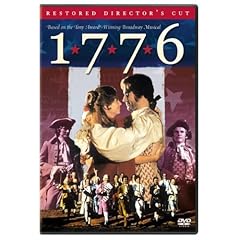
1776 Musical great movie to use in the classroom when studying the american revolutionAnd I'm sure this counts as music, but the movie '1776' is a musical. I've used that as well. That movie is a great way to personify the Constitution Convention and the seriousness of the Declaration of Independence. The kids like to see Mr. Feeney (William Daniels) from Boy Meets World, who plays John Adams.

And there are dozens of other ideas I've had about using music in the classroom. I would love to hear more ideas. And I know that people read this blog, my statistics tell me so... so please leave a comment and share your thoughts.

Read More...

Sunday, February 17, 2008

A Brief History of President's Day -

George Washington and Abraham Lincoln Presidents Day imageBecause I'm curious and I like to share the fruits of my curious mind, I once again present to you the true history of another American Holiday. This time, it is Presidents' Day's turn.

In 1796, during the last full year of Washington's presidency the United States decided to honor their great president by celebrating his birthday. Washington was born on February 22, 1732. Though according to the old style calendars which predate the mid-18th century his birthday falls on February 11. I know it's confusing.

By the early 1800s Washington's Birthday had become an established, though not official, national holiday. Americans would honor Washington by throwing lavish Balls and receptions attended by prominent socialites and public figures. The common man would celebrate, as we American's still do, by gathering in public houses and taverns to honor Washington as another excuse to drink.

Then another well-respected February born president came onto the scene. Abraham Lincoln, whose birthday falls on the 12th of February, was formally honored on his birthday in 1865, one year after his assassination. To commemorate his death, both houses of Congress gathered for a memorial address, on the day of his birth.

Unfortunately for Lincoln, his birthday did not become a legitimate national holiday like Washington's did, but it did become a legal holiday in several states.

Washington's Birthday became an official holiday in 1880, becoming the first federal holiday to honor an American citizen. It was to be celebrated on February 22.

Don't click away yet... there's more.

In 1968, legislation was put in place to simplify yearly calendars and give federal employees some fixed 3-day weekends. The act started in 1971 shifting the observation of Washington's Birthday to the third Monday in February instead of on the 22nd. And although this holiday is still officially known as Washington's Birthday, it has become popularly known as Presidents' Day. This now makes the third Monday in February a day for honoring both Washington and Lincoln. Though I'm pretty sure it's okay to honor other presidents as well.

And in true American fashion, Presidents' Day is also synonymous with sales and shopping. Do you think George and Abe mind people honoring them by buying discounted appliances?

PS - Though most put the possessive apostrophe for President's Day after the 'T' (like I did here and in in my title for search engine optimization reasons), it is incorrect. This spelling indicates a day belonging to one President, while putting the apostrophe after the 'S', in spelling Presidents' Day, indicates a day belonging to more than one President.

Read More...

Tuesday, February 12, 2008

Abraham Lincoln's Birthday: February 12, 1809

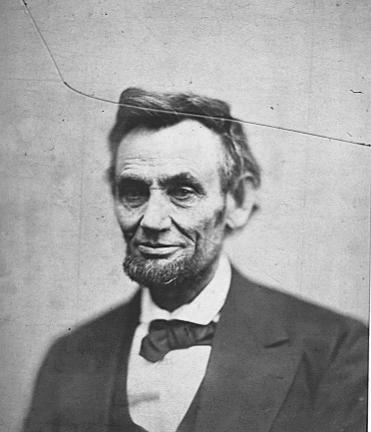
photo of abraham lincolnToday marks the 199th birthday of Abraham Lincoln.

Don't get too excited. Plans have been in place for some time to celebrate Lincoln's Bicentennial with pomp and circumstance which is befitting for such an outstanding historical figure.

In Illinois, they take Lincoln's birthday seriously as all Chicago public schools and state offices will be closed. Although garbage will be picked up as normal. I'm sure Abe wouldn't have it any other way.

Lincoln was born in Hodgenville, Kentucky, where apparently everything is named Lincoln. And where the lion share of the Bicentennial celebration will occur.

He spent his summers in Washington DC.

He spent much of his childhood in Indiana, where there is a national memorial. And where Indiana will also be celebrating Lincoln's 200th birthday. And where Spencer County Indiana is excited for all the publicity.

And now this guy is claiming Lincoln's ties to Idaho are stronger than any other state.

All of this begs the question... which state is Lincoln's true home state? My thoughts are all of them can claim Lincoln as their own. Can't we in Philadelphia and those in Cincinnati both claim Pete Rose?

Want to figure it all out... try ALincolnBlog.Blogspot.com, by Brian Dirck, professor at Anderson University and author of several Lincoln books. It is always my first stop for Lincoln information.
Here's his take on the states claiming Lincoln.

The Lincoln Bicentennial website really is a cool site. It has a Lincoln quiz, an interactive timeline, all sorts of Lincoln information, and lesson plans for teachers. Check it out - http://www.lincolnbicentennial.gov/

Oh... and Happy Birthday Abe.

Read More...

Thursday, January 31, 2008

The Antiques Roadshow Takes A Closer Look at American History

While aimlessly flipping the channels a few nights ago, which doesn't happen as much as it used to now that we've upgraded to DVR, I stopped on the Antiques Roadshow.

This show always intrigues me with the background and history associated with each item. The appraisers are often times extremely knowledgeable in history and will associate the piece and how it was made with the era from which it came. To me, this makes the show very much worth watching.

But this night of the Antiques Road Show became especially enjoyable when they focused on a political sign from the 1840 election brought in by a man who inherited it from his family. The story goes that his great-grandmother, had made the sign in support of James K. Polk. The banner was appraised at $5-7,000 at auction.

His father's grandmother, was related to Abraham Lincoln. "One branch of the Lincoln family produced a gentleman by the name of Abraham," he told appraiser Catherine Williamson of Bonham & Butterfields in Los Angeles. "And the other branch of the family produced me."

I find it curious that during that era women weren't allowed to vote. But in the true democratic fashion, this woman decided to take the time to hand paint letters onto a banner which was approximately 15 by 6, using stencils. This was her way of campaigning.

Her favorite, Polk eventually did win the election on his platform of territorial expansion. He favored the annexation of Texas and the acquisition of the entire Oregon Territory, which at that time was shared with Britain. He was also pro-slavery. Polk was obviously the democratic nominee.

On the other hand Clay, representing the Whigs, had lost elections in 1824 and 1832, was against expansion and was anti-slavery. I've always been a big fan of Henry Clay, mostly because he was a man of strong convictions. He was never willing to give up. Known as the Great Compromiser his skill in negotiations staved off the Civil War twice in in 1820 with the Missouri Compromise and again with the Compromise of 1850. He also ran for president 5 times.

But back to the task at hand...

You can see the whole appraisal here: http://www.pbs.org/wgbh/roadshow/archive/200702A10.html

Who knew the Antiques Roadshow was so Web 2.0. They have archived every appraisal they've done on TV and created a pretty cool search engine to find them too.

I tuned out after that, but was a little upset that I didn't continue watching. What came next was from the personal archives of the White House photographer for JFK.

"I was in Dallas during the horrible assassination," he told appraiser Francis Wahlgren of Christie's in New York as he recounted the details of that day. Once he realized Kennedy had died, he got on the plane with Lyndon Johnson and Jacqueline Kennedy and photographed Johnson's swearing-in ceremony.

The value of that photograph, autographed by LBJ, was $50,000, while a signed photo of the Kennedy family was appraised at $25,000.

And apparently this was THE episode to watch for american history aficianados as a Civil War Henry Repeating rifle was also appraised.
http://www.pbs.org/wgbh/roadshow/archive/200702A34.html

References:

Article about Antiques Roadshow - http://www.floridatoday.com/apps/pbcs.dll/article?AID=/20080126/LIFE/801260301/-1/archives

Missouri Compromise - http://en.wikipedia.org/wiki/Missouri_Compromise
Compromise of 1850 - http://en.wikipedia.org/wiki/Compromise_of_1850

Read More...

Saturday, November 24, 2007

FDR and Two Thanksgivings

Two Thanksgivings; a dream to some and a nightmare for others, depending on whether you're eating or cooking. In 1939 there really was two Thanksgivings.

At the beginning of Franklin Roosevelt's presidency, Thanksgiving was not a fixed holiday. At that time it was up to the President to issue a Thanksgiving Proclamation to announce what date the holiday would be. Most presidents would follow suit and announce the holiday as the last Thursday in November.

Many believe that the Pilgrims chose this day, but that is not the case. It was 1863 when President Lincoln began the observance of Thanksgiving in November, making it a national holiday. Lincoln's decision came in the middle of the Civil War and seems to be an awkward attempt to bring faith back into a war-torn country. Below is an excerpt from Lincoln's Thanksgiving Proclamation:

I do therefore invite my fellow-citizens in every part of the United States, and
also those who are in foreign lands, to set apart and observe the last Thursday of November next as a day of thanksgiving and praise to our beneficent Father who dwelleth in the heavens.
Here's the full text of Lincoln's Thanksgiving Day Proclamation, from October 3, 1963.

Like all the presidents that preceded him, FDR kept tradition until he felt other circumstances would supersede tradition. What circumstances you ask? How about the economy and the Great Depression.

In 1933, FDR's first year in office, Thanksgiving fell on November 30th, the last day of the month and the 5th Thursday. Because statistics showed that most people did not do their Christmas shopping until after Thanksgiving businesses feared a loss in revenue. November 30th left only 24 shopping days between Thanksgiving and Christmas.

Many business owners asked President Roosevelt to make Thanksgiving one week earlier. The requests were ignored until 1939, when Thanksgiving was once again due to fall on the last day of the month. This time FDR listened to the requests and moved Thanksgiving to November 23rd and not November 30th.

This simple date change seemed easy enough, but in actuality proved to be a short-sighted blunder. Thousands of letters poured into the White House from small businesses, calendar manufacturers and universities claiming that the date change will actually harm and/or disrupt their business or routine.

While some retailers were pleased to have the extra week of holiday shopping, smaller businesses claimed they'd lose business to the larger stores. Calendar makers had already printed some of their calendars years in advance making their future supplies now obsolete and out of date. Some Americans were simply upset with Roosevelt's attempt to alter the long-standing tradition just to help businesses make more money. And finally, schools with annual Thanksgiving day football games were now forced to reschedule, and so on and so forth.

Some of these letters can be found at the FDR Library: http://www.fdrlibrary.marist.edu/thanksg.html

With increased opposition, some states refused to honor the new date and kept November 30th as Thanksgiving day. Depending on which state you were from determined which date Thanksgiving was observed. So those living in Connecticut would not have the same day off as those living in New York and thus, family and friends were unable to celebrate the holiday together.

A stubborn FDR continued to observe Thanksgiving on the second to last Thursday of November for two more years/ The amount of public outrage eventually convinced Congress to pass a law on December 26, 1941, declaring Thanksgiving as the fourth Thursday of November every year.

For more Thanksgiving history, visit this timeline: http://memory.loc.gov/learn/features/thanksgiving/timeline/1541.html

Read More...

Monday, November 19, 2007

The Gettysburg Address - November 19,1863

On this day, 144 years ago, approximately 6 weeks after 7,500 men died in a 3 day battle, 1 man, bellowed 10 sentences and 272 words in 3 minutes. Little did he know that this short speech would eventually become the most quoted speech in United States history. And for good reason.

The speech rang true with many, even to this day as establishing "a new birth of freedom". It was a speech that would bring equality to all citizens, and create a unified nation where the rights of the states were no longer dominant. This man declared a government of the people, by the people, and for the people.

What many probably don't know is that this speech almost didn't happen. The Abraham Lincoln Blog has a pretty cool primary document of a letter addressed to Lincoln asking him for "A Few Appropriate Marks", leaving Edward Everett, a popular orator of the time to be the main attraction.


Funny to think that the President of the United States was playing second fiddle and received the invitation less than 3 weeks before the scheduled event. The Abraham Lincoln Blog has the full text of the letter. (thanks for bringing this to our attention)

And without further ado ... Abraham Lincoln's "Gettysburg Address", November 19, 1863

"Four score and seven years ago our fathers brought forth on this continent a new nation, conceived in Liberty, and dedicated to the proposition that all men are created equal.

Now we are engaged in a great civil war, testing whether that nation, or any nation, so conceived and so dedicated, can long endure. We are met on a great battle-field of that war. We have come to dedicate a portion of that field, as a final resting place for those who here gave their lives that that nation might live. It is altogether fitting and proper that we should do this.

But, in a larger sense, we can not dedicate—we can not consecrate—we can not hallow—this ground. The brave men, living and dead, who struggled here, have consecrated it, far above our poor power to add or detract. The world will little note, nor long remember what we say here, but it can never forget what they did here. It is for us the living, rather, to be dedicated here to the unfinished work which they who fought here have thus far so nobly advanced. It is rather for us to be here dedicated to the great task remaining before us — that from these honored dead we take increased devotion to that cause for which they gave the last full measure of devotion — that we here highly resolve that these dead shall not have died in vain — that this nation, under God, shall have a new birth of freedom — and that government of the people, by the people, for the people, shall not perish from the earth."
PS - A new photo of Abraham Lincoln at the Gettysburg memorial ceremony was found. It is the first such discovery since 1952. Here is the link...

Read More...

Wednesday, May 23, 2007

Lincoln On Leadership: Circulate Amongst the Troops

I'm in the process of reading a pretty good book for executives and historians alike. It discusses executive strategies in leadership using Abraham Lincoln's approach. You'll learn a lot about the person underneath the Stovepipe hat and even more about the person reading the book (Yes, you!)

The first chapter's advice is to " Get out of the Office and Circulate among the Troops".

Lincoln surely did this. Often times Lincoln would be found with the troops, riding his horse through the ranks, amidst a background of cheers and applause. Lincoln found that casual contacts with "subordinates" was as important as formal meetings. He believed that people would feel less intimidated and be more open when in a relaxing atmosphere, as opposed to closed up in a meeting room.

Lincoln was known for motivating the troops by telling them his long term vision of the United States. From this, the troops would see the big picture and understand their role in that picture. Giving someone a sense of importance is a motivating factor which is very effective.

The picture to the right shows Lincoln who came to Antietam after the Battle of Bull Run to fire General McClellan. The picture shows Lincoln amongst the troops after the battle. Surely, Lincoln could have fired McLellan via telegram. But Lincoln is a stand up guy and probably used this as a way not to show panic amongst the troops.
The picture to the left is Lincoln talking to McClellan.

To this note, it is well known that Lincoln changed Civil War generals several times before sticking with U.S. Grant. Some say Lincoln was too involved in the decisions of the war, or that he was micromanaging. The fact remains, he did what needed to be done to keep the Union together. This could be an entirely new entry, so I'll leave it at that.

Honest Abe had an open door policy and would rarely turn anyone away. According to some observers he would spend 3/4 of his time out of the office taking what Lincoln referred to as "public opinion baths". Literally bathing himself in the thoughts of the common man. Lincoln himself said, "I have little time to read the papers and gather public opinion that way... as a whole [it] is renovating and invigorating."

Obviously, in this day and age, it is a lot harder for a president to 'circulate' amongst the common man without causing chaos. Lincoln would often refuse protection and was comfortable with his ability to relate to everyone. His amiability was one of his best qualities. A quality which allowed him to gain trust from the common man. He was self-deprecating in social settings, in such a way where his stories, would keep people entertained, but at his own expense. This, might be a result of his melancholy and a way to hide his true feelings of depression. Regardless, he was very like-able in these situations.

During the War, Lincoln could usually be found sitting next to the telegraph machine waiting for the latest battle update. This, instead of waiting across the street in his office for a messenger to deliver the news. This strategy, of looking over the decoder's shoulder, allowed Lincoln to read the telegram quickly, and immediately write a response to be quickly relayed back to the appropriate party. It allowed him to make quick decisions, something that is vital in times of war.

Future leaders can learn from Lincoln's example of getting wide acceptance of a philosophy by demonstrating it in your everyday actions. By entering your subordinate's environment, you establish a frequent human contact which develops a sense of commitment and community. With this comes trust and access to vital information that might otherwise be spread behind your back.

There is no question that Lincoln's style was effective.
PS - The book is: Lincoln on Leadership: Executive Strategies for Tough Times. It is a quick read which gives you great insight into how Lincoln operated.

Read More...