Looking for a way to share your powerpoints with your students? A way for them to view them from home... SlideShare.net is your answer.
Slideshare allows you to easily upload your powerpoint to their website, for easy viewing by the public. Simply send the kids the URL, or input their slideshare widget on your blog or website, and your good to go.
http://www.slideshare.net/
Thursday, April 02, 2009
Links to History: SlideShare.net


Friday, March 27, 2009
Links to History: PastTimesNews.com
 Past Times News; Reporting the Rare and Unusual Stories from America's Past
I don't remember how I stumbled across this, but I'm glad I did.
Past Times News is a newspaper written in today's vernacular about events that happened in the past. It's like a newspaper from the past being delivered today. Though for some reason they're not taking any new subscriptions. You can purchase from their archived collection.
http://www.pasttimesnews.com
The idea is simple. Take events of the past and write about them as if they just happened. This would be great if each issue concentrated on one particular era in history. For example a teacher could purchase the stories of 1776 and have the students report on them as if they were current events.
Each issue comes with a bibliography of their sources and a game in the form of a jumble. Click this link to see what each issue can offer: http://www.pasttimesnews.com/vol2issue8/index.php
Here's an excerpt from the article, How to Save Your Family from Imminent Disease and Death
Lethal bacteria spawning on your dish rag, vicious microbes wriggling in the water you gulp, ravenous tapeworm larvae nestling in your breakfast sausage––if only these microscopic monsters were visible to the naked eye, people would be far more careful about keeping their homes clean. Although we are living in the year 1913, years since Louis Pasteur first revealed the unseen organisms causing decay and disease, many people still don’t know the essential measures that need to be taken to protect themselves from such tiny terrors.
Based in Philadelphia, Past Times News seems like a great idea. Perhaps I'll try to contact them to see why they've stopped publishing new material. Maybe they need writers. Any takers?
Each issue is $5.95... not too much to pay for a few lessons, right?
Monday, March 23, 2009
Textbook Publishers Rush to Include Obama
As much as we dislike certain textbooks and the textbook companies, they should be given credit for this...
http://www.nytimes.com/2009/03/22/education/22textbook.html?_r=1
I can vouch for this. A few months ago I received a government textbook which had Obama in it, as well as Philadelphia's new Mayor, Michael Nutter.
Friday, March 13, 2009
The Impeachment of Andrew Johnson
The New York times has a cool feature where they've archived all of their old articles online. In this case, they've referenced the impeachment trial of Andrew Johnson, which began on this day, March 13, 1868. It's pretty cool reading the newspaper articles in the vernacular of the time.
http://www.nytimes.com/learning/general/onthisday/big/0313.html#article
Today also marks the day that Standard Time was adopted in the United States in 1884.
Monday, March 02, 2009
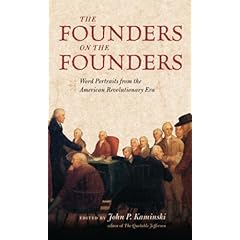
The Founders on the Founders; Word Portraits from the American Revolutionary Era


Through a collection of quotes from journals, John P. Kaminski profiles 30 of the revolution's best known men and women and gives them a personality. The quotes he's chosen bring out the character of each individual, but with a twist. The twist is that most of the quotes are candid "conversations" (letters written between two people), where they talk openly and honestly about someone else. This, is what reveals the WORD PORTRAIT of that individual. The result is fascinating.
Take for example, Thomas Jefferson. We mostly know Jefferson as the quiet, eloquent, peace maker, who would greet people in the White House wearing his slippers. Kaminski's book reveals much more.
Written chronologically, each chapter profiles the men and women of the Revolution as we rarely see them. The book reveals a Jefferson who is vulnerable, heartbroken, depressed and inconsolable. A series of letters between James Madison and Edmund Randolph (Member of the Continental Congress, and would eventually become Va. Governor and Secretary of State) help to tell this story. I've inluded one example below.
James Madison to Edmund Randolph - September 30, 1782 (on Jefferson)
"Mrs. Jefferson has at last shaken off her tormenting pains by yielding to them, (she died Sep. 6) and has left our friend inconsolable... I scarcely supposed, that his grief would be so violent, as to justify the circulating report, of his swooning away whenever he sees his children."A side of Jefferson we rarely think about, a new portrait of the man we associate with pride and eloquence. A word portrait, as painted by the men who new him best.
 The book, The Founders on the Founders is a great reference to reveal the true spirit of our founding fathers.
You can read more about the book here: The Founders on the Founders: Word Portraits from the American Revolutionary Era
Sunday, February 15, 2009
Presidential Love Letters

John and Abigail Adams
The first letters I attempted to find were those from John and Abigail Adams. As was the custom in those times, both John and Abigail chose pen names. John was Lysander, a Spartan war hero. Abigail at first was Diana, the Goddess of the moon, but later used the name Portia, the wife of Brutus a great Roman politician. Below is a letter from Abigail to her "Dearest Friend" John, from December 23, 1782.
See more letters and more information about John and Abigail below: http://www.libraryonline.com/default.asp?pID=57…should I draw you the picture of my Heart, it would be what I hope you
still would Love; tho it contained nothing new; the early possession you
obtained there; and the absolute power you have ever maintained over it; leaves
not the smallest space unoccupied.
My Dearest Friend, Letters of Abigail and John Adams

Abraham Lincoln
Nothing would make me more miserable than to believe you miserable – nothing
more happy, than to know you were so... ...If it suits you best to not
answer this farewell – a long life and a merry one attend you.
Harry Truman
And though these are not transcribed and tough to read, here are some letters from Harry Truman courting his love.
Other Presidents
And finally... a Who Said it? Presidential quiz featuring love letters from some our nation's great leaders. http://ww.neh.gov/news/humanities/2009-01/LoveLetters.html
And on a final note concerning The Kennedy's. It is reported that Jackie had burned her letters from celebrity suitors so that her secret affairs would remain a secret.
I'm sure there are plenty more out there, so if this has peaked your interest. Off you go... find more. And please share them here... Happy Valentine's!
Wednesday, February 11, 2009
Links to History: Lincoln's 200th Birthday

* An excerpt from James McPherson's ABRAHAM LINCOLN:
http://blog.oup.com/2009/02/lincoln-mcpherson/
* A series of FAQs with Allen Guelzo author of LINCOLN: A Very Short Introduction:
http://blog.oup.com/2009/02/lincoln_questions/ and http://blog.oup.com/2009/02/abraham-lincoln-faq-part-one/
* A look at how Lincoln almost failed by Jennifer Weber author of COPPERHEADS: The Rise and Fall of Lincoln's Opponents in the North:
http://blog.oup.com/2009/02/lincoln_fail/
Monday, February 09, 2009
Still I Rise; A Graphic History of African Americans
I've noticed in recent years the popularity of graphic-novels. You know, the comic book style books you're students can't seem to put down. Though not quite award-
I was a fan of anything that had kids reading. Whether it be a magazine, a website or a graphic novel. But there was always something about these books that just didn't sit well with me. Maybe it was the fact that they were reading a video game plot and weren't really learning anything.
Still I Rise, changes all that. It's a graphic-novel chronicling the struggle that is the history of African-Americans. This is a new version of the book which extends to the Presidency of Barack Obama. The previous version released several years ago stopped at the million man march.
From the slave trade to Denzel Washington and Halle Berry, Still I Rise: A Graphic History of African Americans
Some of local Philadelphia significance include James Forten and Richard Allen, to name just a few.
I liked the book so much I'm going to propose that it become a necessary text for teaching African-American history at my school. It is the perfect compliment to any text. There is not an event in African -American history left unturned.
Still I Rise: A Graphic History of African Americans - is much more than a comic book. It's got content. History is drawn onto every page. From Amistad and Nat Turner's rebellion to Abraham Lincoln and the assassination of Martin Luther King.
The book will do wonders in getting your students engaged. They won't see it as a text, but as a comic book. There are so many extension activities you can do within the pages of this book.
I liked the book so much I'm going to propose that it become a necessary text for teaching African-American history at my school. It is the perfect compliment to any text. There is not an event in African -American history left unturned.
Still I Rise: A Graphic History of African Americans
- is much more than a comic book. It's got content. History is drawn onto every page. From Amistad and Nat Turner's rebellion to Abraham Lincoln and the assassination of Martin Luther King.The book will do wonders in getting your students engaged. They won't see it as a text, but as a comic book. There are so many extension activities you can do within the pages of this book.
For example:
Students can choose a character from the book and create a mini-comic book highlighting a day in the life of that character.
The can research and write a biography of one or more of the people in the book. Would be more challenging to choose someone they've never heard of. And there will be plenty.
Students can choose a character from the book and create a mini-comic book highlighting a day in the life of that character.
The can research and write a biography of one or more of the people in the book. Would be more challenging to choose someone they've never heard of. And there will be plenty.
You could take certain scenes, vignettes from the book and have your students create a movie trailer for a movie about the event.
Regardless, your kids will read the book. They'll learn history.
Saturday, February 07, 2009
Thinkin' You Know Lincoln? - Lincoln Lesson Plan Contest

Teachers have until April 8, 2009 to submit a lesson plan to be judged on relevance to curriculum, clarity of expression, use of primary sources and innovative and/or multi-media strategies, and an explanation of the assessment method.
For more information about the Abraham Lincoln contest, click on the link below:http://www.history.com/content/give-a-lincoln/lincoln-contest-for-students-and-teachers
After clicking on the link, be sure to check out the teacher resources on the right side of the ensuing page. It's a collection of discussion questions and extension activities that go along with a video you can purchase from the History Channel, but in my experience, you can often find something similar for free in other places.
For more Abe Lincoln resources, check out some of the sources below:
Wednesday, February 04, 2009
Links to History: Black History Month Lesson Plans and Resources

At Thinkfinity.org you'll find lots of free educational resources for standards-based K-12 lesson plans, educational games, music clips and videos – all relating to Black History Month and available for downloading.
Thinkfinity.org, is the educational website of the Verizon Foundation, and the the Black History Month related free lesson plans, teacher resources and student activities on the site are great for your classrooms.
The American Federation of Teachers website, also has some decent resources: http://aft.org/teachers/black-history.htm
The AFT has identified a variety of resources to help educators celebrate Black History Month in their classrooms. This site highlights key historical events, influential figures and the continuing contributions African-Americans are making to our nation and the world.
It's also got some facts and figures which could make for good class discussion.
For example:
1.1 million is the number of blacks with advanced degrees, which is nearly twice the number from 1995.
You could ask your class to consider the reasons for such a huge increase.
And as always, the USHistorySite.com has plenty of pages with links to lesson plans on a variety of appropriate topics. Here are a few:
If you've got some of your own, please share them below.
Saturday, January 31, 2009
Obama Follows in Lincoln's Footsteps
 Most of us are familiar with President Obama wanting to take a train from Philadelphia, to his inauguration in Washington, D.C. Obama wanted to trace the route Lincoln took to his inauguration.
Obama's trip included a stop in Delaware to pick up Vice President-elect Joe Biden and a stop in Baltimore for a speech. But Lincoln was not originally scheduled to go to Delaware.
Lincoln was scheduled to make the trip from Springfield, east to Philadelphia to Harrisburg and finally from Harrisburg to Baltimore. But his trip did not go as planned.
So why did Lincoln make a stop in Philadelphia? And what happened that forced him to change his plans?
On February 11, 1861, Lincoln bid adieu to his supporters in Springfield, Illinois, and boarded a train east with an eventual destination of Washington. With several stops along the way, Lincoln finally arrived in Philadelphia on February 21.
Here is a link to one of his stops in Peekskill, NY, on February 19.
http://www.johngtesta.com/lincoln.html
The website belongs to the Mayor of Peekskill, John Testa and has some pretty cool information about Lincoln's stop there, and a statue dedication. Seems like a cool resource for Lincoln aficianados.
February 21st was George Washington's Birthday, and Lincoln was in Philadelphia to celebrate the event at Independence Hall. The night before arriving in Philadelphia, Lincoln's party was alerted to a plot to assassinate the President-elect by derailing the train from Harrisburg to Baltimore and killing Lincoln and everyone on board, or by attacking his carriage once he reached Baltimore.
Because of this, Lincoln decided to change his plans. He continued to Harrisburg as scheduled, but then decided to secretly return to Philadelphia to avoid the assassination attempt. All telegraph lines from Harrisburg were cut and guards were posted at various points along the train's route to ensure Lincoln's safety.
Once in Philadelphia, Lincoln transferred to a train in Wilmington, Delaware and then was once again secretly carried to Baltimore. He arrived in Washington on February 23, safely and in plenty of time before his March 4th inauguration.
Sunday, January 25, 2009
Follow USHistorySite.com on Twitter
I was a little slow to use this tool, but in spending a weekend at the EduCon2.1 conference, I think I'll give it a shot.
https://twitter.com/ushistorysite
Tuesday, January 20, 2009
Friday, January 16, 2009
Barrack Obama Innauguration Lesson Plans
My school district, was nice enough to provide it's teachers with curriculum guides for Tuesday's historic innauguration.
So I'll simply share them with you: http://www.phila.k12.pa.us/offices/curriculum/supports/08-09/Inaug.htm
Subscribe to:
Posts (Atom)


 Posts