Saturday, February 07, 2009

Thinkin' You Know Lincoln? - Lincoln Lesson Plan Contest

abraham lincoln lesson plan contest primary source documentsIn honor of Lincoln's 200th Birthday on February 12th, the History Channel is sponsoring a Lincoln Lesson Plan Contest.

Teachers have until April 8, 2009 to submit a lesson plan to be judged on relevance to curriculum, clarity of expression, use of primary sources and innovative and/or multi-media strategies, and an explanation of the assessment method.

For more information about the Abraham Lincoln contest, click on the link below:http://www.history.com/content/give-a-lincoln/lincoln-contest-for-students-and-teachers

After clicking on the link, be sure to check out the teacher resources on the right side of the ensuing page. It's a collection of discussion questions and extension activities that go along with a video you can purchase from the History Channel, but in my experience, you can often find something similar for free in other places.

For more Abe Lincoln resources, check out some of the sources below:

Read More...

Wednesday, February 04, 2009

Links to History: Black History Month Lesson Plans and Resources

Here are some links to resources to help in planning for Black History Month.

At Thinkfinity.org you'll find lots of free educational resources for standards-based K-12 lesson plans, educational games, music clips and videos – all relating to Black History Month and available for downloading.

Thinkfinity.org, is the educational website of the Verizon Foundation, and the the Black History Month related free lesson plans, teacher resources and student activities on the site are great for your classrooms.

The American Federation of Teachers website, also has some decent resources: http://aft.org/teachers/black-history.htm

The AFT has identified a variety of resources to help educators celebrate Black History Month in their classrooms. This site highlights key historical events, influential figures and the continuing contributions African-Americans are making to our nation and the world.

It's also got some facts and figures which could make for good class discussion.
For example:
1.1 million is the number of blacks with advanced degrees, which is nearly twice the number from 1995.
You could ask your class to consider the reasons for such a huge increase.

And as always, the USHistorySite.com has plenty of pages with links to lesson plans on a variety of appropriate topics. Here are a few:

If you've got some of your own, please share them below.

Read More...

Saturday, January 31, 2009

Obama Follows in Lincoln's Footsteps

Most of us are familiar with President Obama wanting to take a train from Philadelphia, to his inauguration in Washington, D.C. Obama wanted to trace the route Lincoln took to his inauguration.

Obama's trip included a stop in Delaware to pick up Vice President-elect Joe Biden and a stop in Baltimore for a speech. But Lincoln was not originally scheduled to go to Delaware.

Lincoln was scheduled to make the trip from Springfield, east to Philadelphia to Harrisburg and finally from Harrisburg to Baltimore. But his trip did not go as planned.

So why did Lincoln make a stop in Philadelphia? And what happened that forced him to change his plans?

On February 11, 1861, Lincoln bid adieu to his supporters in Springfield, Illinois, and boarded a train east with an eventual destination of Washington. With several stops along the way, Lincoln finally arrived in Philadelphia on February 21.

Here is a link to one of his stops in Peekskill, NY, on February 19.
http://www.johngtesta.com/lincoln.html
The website belongs to the Mayor of Peekskill, John Testa and has some pretty cool information about Lincoln's stop there, and a statue dedication. Seems like a cool resource for Lincoln aficianados.

February 21st was George Washington's Birthday, and Lincoln was in Philadelphia to celebrate the event at Independence Hall. The night before arriving in Philadelphia, Lincoln's party was alerted to a plot to assassinate the President-elect by derailing the train from Harrisburg to Baltimore and killing Lincoln and everyone on board, or by attacking his carriage once he reached Baltimore.

Because of this, Lincoln decided to change his plans. He continued to Harrisburg as scheduled, but then decided to secretly return to Philadelphia to avoid the assassination attempt. All telegraph lines from Harrisburg were cut and guards were posted at various points along the train's route to ensure Lincoln's safety.

Once in Philadelphia, Lincoln transferred to a train in Wilmington, Delaware and then was once again secretly carried to Baltimore. He arrived in Washington on February 23, safely and in plenty of time before his March 4th inauguration.

Read More...

Sunday, January 25, 2009

Follow USHistorySite.com on Twitter

I was a little slow to use this tool, but in spending a weekend at the EduCon2.1 conference, I think I'll give it a shot.

https://twitter.com/ushistorysite

Read More...

Tuesday, January 20, 2009

Living History: Barack Obama's Inaugural Speech


Read More...

Friday, January 16, 2009

Barrack Obama Innauguration Lesson Plans

My school district, was nice enough to provide it's teachers with curriculum guides for Tuesday's historic innauguration.

So I'll simply share them with you: http://www.phila.k12.pa.us/offices/curriculum/supports/08-09/Inaug.htm

Read More...

Monday, December 29, 2008

Links to History: TimeRime.com

As educators and historians we can all appreciate a good timeline. Timelines are a great tool to use in the classroom to give the students perspective and an ability analyze dates and events in sequential order and it's a way that kids learn, without knowing they're learning. Try having thee kids make a timeline of important events in a chapter instead of answering questions at the end. I guarantee they'll be more engaged.

If you're lucky, you have a computer lab or a laptop cart where you can have the kids create timelines online, check off that technology quota and draw them in even more.
Here are several places to do that.

http://www.teach-nology.com/web_tools/materials/timelines/
http://www.readwritethink.org/materials/timeline/

You can find a plethora of timelines and links to timelines on my US History website: http://USHistorySite.com/timelines.php

But here's the timeline creator of all timelines - TimeRime.com:

This is not your typical timeline. TimeRime takes time lines to the next level by adding a level of interactivity with images, a scrolling feature and so much more which can't possibly be described. You'll just have to see it for yourself.

Though making a timeline with TimeRime could take a considerable amount of time, the results can be fantastic. Imagine the ideas you can bring to the table with pictures, and words with perspective of what came first, second and so on.

Below, I've embedded a timeline of Barrack Obama from TimeRime.com to give you a sense of some of the capabilities.


Read More...

Wednesday, December 24, 2008

A Brief History of the "Americanization" of Christmas

I think we can all agree that the modern day Christmas holiday is a far cry from the true meaning of celebration of the nativity. And though there are still many Americans who do celebrate the birth of Christ. Those that do break bread and un-wrap gifts with visions of wise man dancing in their heads, still have a lot owed to the minds behind the Americanization of Christmas.

Let's start with Santa Claus. The name Santa Claus is derived from St. Nicklaus. Nicholas lived sometime during the 3rd century in what is now the southern coast of Turkey. Nicholas was known for his generosity and his patronage to the poor, so the idea of Santa Claus is no stretch. And holidays celebrating St. Nicholas.

But what's the deal with the flying reindeer? And what's with the sneakiness through the chimney? These things, along with idea for Rudolph are pure 19th and 20th century American adaptations.

The image of the jolly old elf was developed from the 1823 poem "A Visit from St. Nicholas," better known now as "The Night Before Christmas." The poem's authorship has been disputed over the years, but what is truly remarkable is the imagination to turn St. Nick into a sleigh riding elf who used magical flying reindeer to descend onto the roofs of good girls and boys.

The 8 tiny reindeer were purely a product of the author's imagination. Regardless of whether the author is Clement C. Moore or Henry Livingston, millions of kids still check the weather reports and check the night sky to make sure Ol' St. Nick can get to their house safely.

Here's the vision of St. Nicholas from the poem.

"He was dressed all in fur, from his head to his foot,
And his clothes were all tarnished with ashes and soot;
A bundle of toys he had flung on his back,
And he looked like a peddler just opening his pack.

His eyes—how they twinkled! his dimples how merry!
His cheeks were like roses, his nose like a cherry!
His droll little mouth was drawn up like a bow,

And the beard of his chin was as white as the snow;
The stump of a pipe he held tight in his teeth,
And the smoke it encircled his head like a wreath;

He had a broad face and a little round belly,
That shook, when he laughed like a bowlful of jelly.
He was chubby and plump, a right jolly old elf. . ."

But these were just words, the true look of Santa came from the famous political cartoonist, Thomas Nast. In 1863 Nast was commissioned to draw a series of annual drawings of the Santa Claus in Harper's Weekly. His drawings, based on the descriptions from the poem and an earlier Dutch representation of the character. The drawings continued through 1886 and helped to shape the Santa Claus we know and love today.

For a more robust story of the history of St. Nicholas, click on the link below. http://www.stnicholascenter.org/Brix?pageID=35

And then there's Rudolph. Believe it or not, Rudolph came to be as a marketing ploy to entice people to shop at Montgomery Ward. The departments store would release an annual coloring book as a gimmick to promote holiday shopping. In 1939, one of Montgomery Ward's copywriters, Robert L. May, came up with the idea for an ostracized reindeer with whom it would be easy to sympathize. The story was a hit, and thus a promotion to sell more toys has turned into an American holiday icon.

Even Snopes is on the great Rudolph caper: http://www.snopes.com/holidays/christmas/rudolph.asp

Leave it to the great United States to everything bigger, better and brighter!


If you've got some time, here's a pretty informational video about the History of Christmas.

The history of Santa starts at 28:26 into the video, and Rudolph starts at 34.56
-------------------------------


Further reading:

Santa Claus: A Biography

Nicholas: The Epic Journey from Saint to Santa Claus

Read More...

Tuesday, December 09, 2008

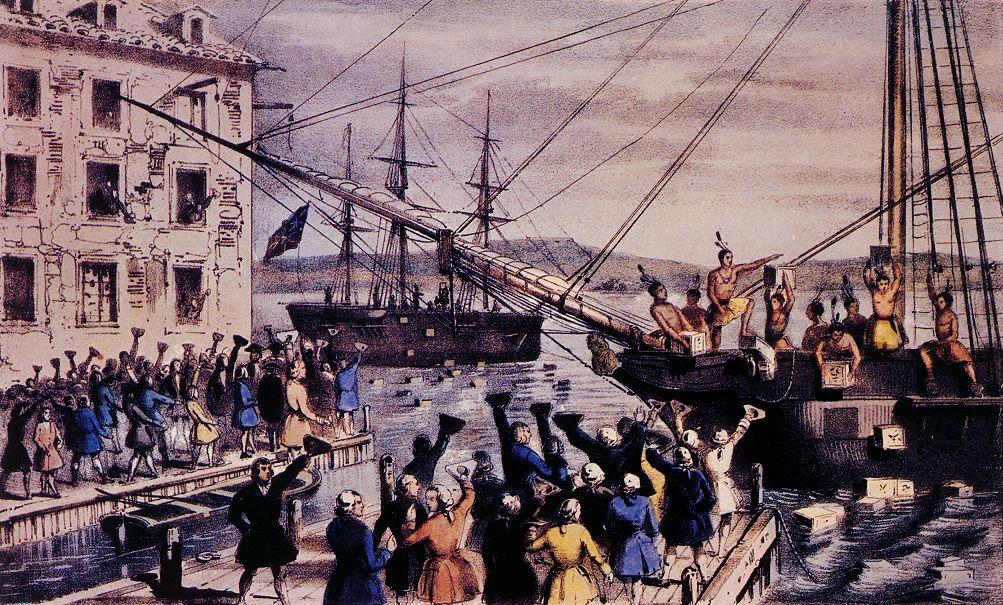
The Boston Tea Party 235th Anniversary

The 235th anniversary of the Boston Tea Party is set for December 16. To commemorate the event the National Constitution Center will unveil The Robinson Tea Chest.

The Robinson Tea Chest? What the heck is the Robinson Tea Chest?

According to history, on December 16, 1773, exactly 342 tea chests were dumped into Boston Harbor in protest of the new tax on tea. The Robinson Tea Chest is one of the lucky surviving tea chests that can trace it's origin to that fateful night.

Along with the chest, the NCC will also display related newspaper articles from the Masachusetts Gazette and the Boston Weekly Newsletter, from December 9, 1773.

The display will also include letters and photographs that chronicle the chest’s history from the time it was recovered in Boston Harbor, December 17, 1773, to now.

If you haven't made a trek to Philadelphia to see the Constitution Center, let alone Independence Hall, the Liberty Bell, Thomas Jefferson's temporary housing, Ben Franklin's house, Betsy Ross's house, etc... then you're missing out. Come to Philadelphia, let me know, we'll meet for a beer.

On another note, the Old South Meeting House holds an annual event commemorating the Boston Tea Party. The old building is the place where more than 5,000 colonists gathered on December 16, 1773 in turn starting the Boston Tea Party.

For more information, or to plan a trip there next year, go to their website: http://www.oldsouthmeetinghouse.org/

Read More...

Links to History: Teaching Economics

Today's trying economic times is enough to make you rethink the direction of our education system and ponder the thought of what is most important in education?

Is it the ability to reduce algebraic equations? Is understanding the leadership qualities of Alexander the Great really that important? What about knowing all of the prepositions and understanding that you shouldn't end a sentence with one of them? Or better yet... how about the value of a dollar and how credit works?

Yep, that could undoubtedly help in times like these.

My first 2 years of teaching, I taught economics, in Atlanta, Georgia. It was a great class, and really engages the students because it is real life... and they knew that. I didn't take economics in high school. I don't even think it was offered. I teach now in Philadelphia, PA and I don't think economics is an option. But it should be.

It is a great thing to foster a young entrepreneur and let them hash out there ideas in a business plan. Young entrepreneurship is what is going to keep this company afloat. And with the advancement of technology, the next great entrepreneur could undoubtedly come from a 12th grade classroom.

Entrepreneurship is all around and the future of our country depends on it. Fortunately there are plenty of foundations out there that help to foster ideas by way of education, support and grants, and help any entrepreneur with taking an idea to fruition. One such place is the Ewing Marion Kauffman Foundation. (http://www.kauffman.org).

The Kauffman Foundation is dedicated to creating a society of economically sound individuals who can contribute positively to their community in the form of staring a business or understanding business from a broader perspective.

The Kauffman Foundation has plenty of free resources for teachers and students. Choose from newsletters, RSS feeds and fact sheets.. they're all free, so check 'em out here.

One of the current resources highlighted on the site discusses math, science and technology in the classroom and see how parents and students truly feel about the current curriculum being taught in school.

I know I'm upset that Pennsylvania doesn't teach Economics. I loved teaching the subject. I became certified in Business Technology which has some economics, just so I could teach when given the chance. But alas, apparently it's not important enough to include in the core curriculum. Entrepreneurship and simple economics should definitely be a priority in any district.

Young entrepreneurship is nothing to shy away from. If anybody knows of any other foundations, or grants out there to help bring economics into schools, please share them.

Read More...

Saturday, November 29, 2008

Using YouTube Videos in the Classroom; Even if the Site is Blocked!

So you've found some useful videos to use in your classroom on YouTube. You can view them fine at home, only to discover that your school district has decided to block YouTube forcing you to go to plan B.

If this happens to you, there are several things you can do.

First you can check out http://teachertube.com/, which is the YouTube for teachers, but there aren't as many good videos to choose from. It's a great idea, but it needs more users to put up some better content. There are a few organizations who have taken to it, and posted some good historical content, but it might be a struggle to find exactly what you're looking for.

And finally you can use Zamzar (http://zamzar.com/) Zamzar is a file conversion website that can convert almost any type of file to the format you desire. In this case, you can input the URL of the YouTube video you desire and convert it into a format that you can save to your computer or your zip disk/thumb drive and access directly from your computer. Sometimes the files are rather large so I don't recommend emailing it, but you can certainly email the URLs of the videos and convert them from your school's computer.

Zamzar is quite simple. Just have it sent to your school email address and save it there. Hopefully you have a network, because the files are quite large, and it would be easier to share with other teachers.

Read More...

Wednesday, November 26, 2008

Mary Had a Little Lamb... for Thanksgiving.

Sara Hale, author of the famous poem, Mary Had a Little Lamb and one the nation's first woman magazine editors played an instrumental part in making Thanksgiving a national holiday.


Ms. Hale worked tirelessly writing letters to the Presidents because she thought it was a good idea to have a holiday where all Americans could collectively give thanks. Her passionate letters and essays finally caught up with Abraham Lincoln. With a nation divided Lincoln thought the idea was a good one and thus declared the last Thursday in November, as Thanksgiving.

But FDR would later try to move this date up, in an effort to boost the economy and get an extra week for holiday shopping. For one year, 1940, this caused much confusion, so much that America actually had two Thanksgivings that year. Some states recognized FDR's decree, while others still followed Lincoln's last Thursday declaration. Congress eventually agreed to make it the 4th Thursday of the month instead of the last Thursday. You can read about the whole story here.

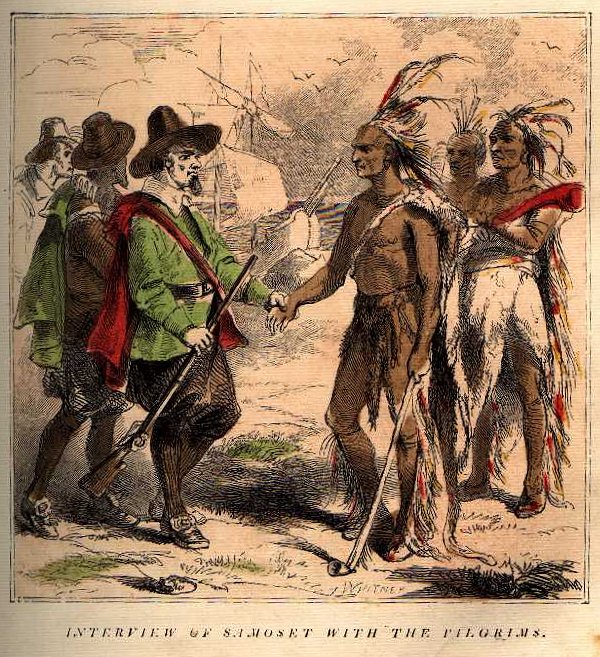
The first Thanksgiving, the one celebrated in 1621 by Plymouth (or Plimouth) colonists and Wampanoag Indians, didn't have lamb on the menu... but it may have had turkey.

There are only two items historians know for sure were on the menu; venison and wild fowl. These are mentioned in primary sources.

Below is one of the more detailed descriptions of the "First Thanksgiving". It comes from A Journal of the Pilgrims at Plymouth, in 1621, by Edward Winslow:
"Our harvest being gotten in, our governor sent four men on fowling, that so we might after a special manner rejoice together after we had gathered the fruit of
our labors. They four in one day killed as much fowl as, with a little help beside, served the company almost a week. At which time, among other recreations, we exercised our arms, many of the Indians coming amongst us, and among the rest their greatest king Massasoit, with some ninety men, whom for three days we entertained and feasted, and they went out and killed five deer, which they brought to the plantation and bestowed upon our governor, and upon the captain, and others. And although it be not always so plentiful as it was at this time with us, yet by the goodness of God, we are so far from want that we often wish you partakers of our plenty."
For a full list off what might have been on the menu, including eel and lobster, and what was definitely not on the menu... click the link below: http://www.history.com/minisites/thanksgiving/viewPage?pageId=873

Did You Know That...
According to the Cape Cod Cranberry Growers' Association.The cranberry is one of only three fruits that are entirely native to North American soil.

Without cheating, take a guess at what the other two are...

Happy Holidays.

Read More...

Thursday, November 20, 2008

Failures of the Presidents: Book Review

Failures of the Presidents: From the Whiskey Rebellion and War of 1812 to the Bay of Pigs and War in Iraq

The book's interesting cover is enough to grab your attention. But the interest doesn't stop there. Failures of the Presidents is a quick witted, sarcastic, informative and entertaining look at some of the greatest Presidents' not so great moments.


Though many of the vignettes within the book are familiar only to those that study the subject, the authors do a great job of bringing the reader up to speed quickly so that the context of the chapter is not lost. The book is meant to be read by everyone.

The writing style is well suited for a quick, fun read. Filled with clever comparisons and sarcastic wit, Failures of the Presidents brings a sense of humor to what is usually a more serious subject. But don't let the cover or the clever writing fool you... there are some serious issues addressed.

In all, 20 presidents are highlighted... each a story of its own, making this a great book of short reads. But it is much, much more than one of those quick facts, "Did you know?" type of books many of us get suckered into browsing at the book store. This has some meat.
The images in the book make it great for the coffee table, not to mention the conversation piece the cover can become. It's not often that history books give you pictures to ponder while reading... but the coffee table style of this book is a very welcome deviation to the common history book.

If you've read this book, or anything like it, I'd love to hear your thoughts.... I'm currently reading Secret Lives of the US Presidents, which is another good read along the same lines, but with many more textbook like sidebars.

Both books are in my recommended section in the USHistorySite Online Store... click here to see all my recommended items.

Read More...

Monday, November 17, 2008

"I'm Not a Crook" - Nixon and Watergate

It was on this day, November 18, 1973, before the entire nation, during a televised news conference in response to allegations regarding his involvement in the Watergate scandal that President Richard Nixon declared "I'm not a crook. I earned everything I got. "

This was his attempt at declaring innocence in the whole ordeal.

Nixon continued to deny his involvement in Watergate, even after audio tapes of conversations in the president’s office revealed otherwise. Nixon later resigned from his post as president on August 8, 1974. He resigned shortly after three articles of impeachment were passed. However, Gerald Ford, his successor pardoned him of any wrong doing.

I've always wondered if Nixon really thought he'd be able to talk his way out of it by denying any wrong doing. Did he know they had the tapes on him? And if he did, would he still have said this famous line? Does Clinton and the Monica Lewinsky fiasco fall into the same category? Would admission of guilt from the get-go changed our perception of either of these two ordeals.

Read More...