


Those that have been reading this blog know that I'm a baseball fan. Much more than a baseball fan, I've been a die-hard Phillies' fan my entire life. As a kid I had some very lean years in the mid-80s. Lately, as you may well know, the Phillies have made up for many of those last place finishes. The city has really embraced this team.
Tonight the Phillies are playing the Washington Nationals.
I think it's worth mentioning that the Nationals have a pretty cool tradition at their home games that has great historical significance.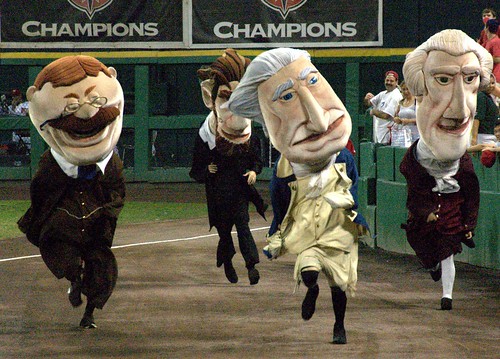
Much like a minor league baseball stunt, to keep the fans entertained between innings, there is a Presidential race. Only this race involves four mascots representing the four presidents on Mount Rushmore.
Every game, George Washington, Thomas Jefferson, Abraham Lincoln and Teddy Roosevelt compete. The race originated as a scoreboard graphic, but has morphed into the "live-action" race pictured above.
There is a running joke that Teddy Roosevelt never wins. He'll often become distracted, or become disqualified for numerous reasons.
For more information about the race, you can read more at wikipedia: http://en.wikipedia.org/wiki/Presidents_Race
By the way, the Phillies are currently winning 6-3 in the 7th.
Showing posts with label Baseball. Show all posts
Showing posts with label Baseball. Show all posts
Wednesday, April 07, 2010
US Presidents Race


Sunday, July 20, 2008
The History of: "Take Me Out to the Ballgame"
 It's been said that it's the third most frequently sung song in America... I'm sure Happy Birthday and The Star-Spangled Banner win the gold and silver.
Every night, during the 7th inning stretch in every major and minor league baseball game, thousands upon thousands of people rise to their feet and sing the song as one.
We all know the chorus by heart... and we sing it loud and proud... it's almost un-American not to. It's as American as baseball... in fact it IS baseball. What would baseball be like without it?
"Take Me Out to the Ball Game" is celebrating it's 100th year as THE baseball song. The irony of the song is that the author had never been to a baseball game.
The story goes that Jack Norworth, a song writer and vaudeville performer, was inspired to write the song when he saw an sign promoting a game at the Polo Grounds, while riding a New York city subway. Norworth's inspiration began by writing a song about a girl named Katie Casey who's boyfriend called to see if she'd like to go to a show... but instead, Katie asked her boyfriend to "Take Me Out to the Ball Game". And in knowing the lyric you can imagine a girl asking her boyfriend to "buy her some peanuts and cracker-jack".
The song was a huge hit... (yep, pun intended, but that was an easy one...) The song was a top 10 hit for three artists in 1908. And it wasn't until the 1934 World Series, when the song was performed at Sportsman’s Park in St. Louis.
For the next several decades, baseball fans would spontaneously sing the song during ball games. Often times between innings or during pitching changes when the organist would play the tune.
What made the song even more popular was its inclusion in the 7th inning stretch of Chicago Cubs games. But this didn't happen until much later and really wasn't planned.
(See a history of the 7th inning stretch here...) Thanks to the robust President Taft, we have a 7th inning stretch...which also was not planned.
The story goes that legendary Cubs play-by-play announcer Harry Caray would privately sing the song during commercial breaks. (Back then he was broadcasting for the other Chicago baseball team...) In 1976, White Sox owner Bill Veeck, known for his wacky promotions and stunts, tricked Caray into leading the White Sox faithful in singing the song at Comiskey Park, by hiding a microphone in the broadcast booth, and allowing all the fans to hear him and sing along. The tradition was started...
Caray carried the tradition to the other side of Chicago when he became the Cubs' announcer in 1982. And because the Cubs were broadcast on Cable television, the entire country got to hear Caray's rendition, and other teams began adopting the tradition. And the rest, as they say... is history. Even after Caray's transition to baseball heaven in 1998 the Cubs continue the tradition by having celebrities sing the song during the 7th inning stretch.
But of course each team would substitute the lyrics to customize the song for their favorite team... in my case it goes "root, root, root for the Phillies..."
For more history of the song, and many other baseball songs you can read Baseball's Greatest Hit: The Story of Take Me Out to the Ball Game 
The Baseball-Almanac, which is an excellent site for baseball enthusiasts, has the complete version of both lyrics, as well as several you can listen to..
http://www.baseball-almanac.com/poetry/po_stmo.shtml
To celebrate the song's 100th anniversary Major League Baseball and Baby Ruth teamed up to create a contest where the winner would sing "Take Me Out to the Ball Game" at this year's All-Star game... Here's the link: http://mlb.mlb.com/mlb/fan_forum/babyruth/ (Tab around this micro-site for more information about the song...)
Take Me Out to the Ball Game (1908 original version)
words by - Jack Norworth
music by - Albert VonTilzer
Katie Casey was baseball mad,
Had the fever and had it bad.
Just to root for the home town crew,
Ev'ry sou Katie blew.
On a Saturday her young beau
Called to see if she'd like to go
To see a show, but Miss Kate said
"No, I'll tell you what you can do:"
Take me out to the ball game,
Take me out with the crowd;
Buy me some peanuts and Cracker Jack,
I don't care if I never get back.
Let me root, root, root for the home team,
If they don't win, it's a shame.
For it's one, two, three strikes,
you're out, At the old ball game.
Katie Casey saw all the games,
Knew the players by their first names.
Told the umpire he was wrong,
All along,Good and strong.
When the score was just two to two,
Katie Casey knew what to do,
Just to cheer up the boys she knew,
She made the gang sing this song:
Take me out to the ball game,
Take me out with the crowd;
Buy me some peanuts and Cracker Jack,
I don't care if I never get back.
Let me root, root, root for the home team,
If they don't win, it's a shame.
For it's one, two, three strikes, you're out,
At the old ball game.
Friday, May 02, 2008
May 2, 1939: Lou Gehrig "The Iron Horse" Ends the Streak
 Lou Gehrig was a man of consistency. In 17 Major League seasons he wracked up a .340 batting average, hit 493 homeruns and collected 1,995 RBIs. In the 16 years preceding the 1939 season, Gehrig averaged 38 homeruns and 150 RBIs.
But through the first 8 games of the 1939 season, Gehrig batted .143 with 1 RBI. The poor start was inconsistent with the true Lou Gehrig. Thus, on May 2, 1939 Gehrig voluntarily benches himself "for the good of the team." Gehrig did make one quick appearance during the game, when he brough the Yankees lineup out to the umpire... but ultimately, his consecutive-game streak was halted at 2,130 games.
Though he didn't know it at the time, Gehrig had contracted amyotrophic lateral sclerosis (ALS, aka Lou Gehrig's Disease). Gehrig's streak would stand for another 56 years. On September 6, 1995, Cal Ripken Jr. played in his 2,131st consecutive game. Ripken would go on to play in an unprecedented 2,632 consecutive games, before he too benched himself for the good of the team.
May 2, 1939, will forever be the day when Gehrig "hung 'em up." Two month's later, on July 4, Gehrig would make his famous Farewell speech at Yankee Stadium. Full text of the speech is below. (Hollywood echo, not included...)
"Fans, for the past two weeks you have been reading about the bad break I got. Yet today I consider myself the luckiest man on the face of this earth. I have been in ballparks for seventeen years and have never received anything but kindness and encouragement from you fans.
"Look at these grand men. Which of you wouldn't consider it the highlight of his career just to associate with them for even one day? Sure, I'm lucky. Who wouldn't consider it an honor to have known Jacob Ruppert? Also, the builder of baseball's greatest empire, Ed Barrow? To have spent six years with that wonderful little fellow, Miller Huggins? Then to have spent the next nine years with that outstanding leader, that smart student of psychology, the best manager in baseball today, Joe McCarthy? Sure, I'm lucky.
"When the New York Giants, a team you would give your right arm to beat, and vice versa, sends you a gift - that's something. When everybody down to the groundskeepers and those boys in white coats remember you with trophies - that's something. When you have a wonderful mother-in-law who takes sides with you in squabbles with her own daughter - that's something. When you have a father and a mother who work all their lives so you can have an education and build your body - it's a blessing. When you have a wife who has been a tower of strength and shown more courage than you dreamed existed - that's the finest I know.
"So I close in saying that I may have had a tough break, but I have an awful lot to live for."
For an audi version of the speech and to find more information, visit the official Lou Gehrig website: http://www.lougehrig.com/
Friday, August 10, 2007
Presidents, Mustaches and Baseball
 This question was posed to me the other day at work: Who was the last president to have facial hair?
Immediately I thought Theodore Roosevelt, circa 1900.
I immediately eliminated anyone from FDR to the present. No president in the so-called modern era would dare have facial hair for fear that they might be labeled a slacker or a liberal...*gasp*!
And then, to the best of my knowledge I tried to think about the era's that occurred after Teddy Roosevelt to eliminate any other possibilities.
The 20s brought us Wilson and Harding, and both of the images I've ingrained in my head don't include facial hair.
I couldn't picture what Calvin Coolidge looked like, but I knew Hoover didn't, so I eliminated Coolidge based on the fact that he was sandwiched between two non-facial-hair-wearing presidents.
So my 30 seconds of thinking, held true my idea that Teddy Roosevelt was the last president with facial hair. I was wrong. I forgot about William H. Taft, our President from 1909-1913, immediately following our good friend Teddy. Taft is one of our more portly presidents, standing 6 feet 2 inches and weighing 350 pounds. It is rumored that he once got stuck in the White House bathtub, and then had a special tub installed that was large enough to hold four men.
Surely there is more to Taft's presidency than his being too large for a bathtub. There is... and we turn to our national past time of baseball to give Taft more dignity.
It was opening day, April 14, 1910 in a game between the Washington Senators and the Philadelphia Athletics at Griffith Stadium in Washington D.C. According to legend, after the managers had been introduced, umpire Billy Evans handed Taft the ball and asked him to throw over home plate. So he did.
As the big-wig owner of the Washington Senators, Clark Griffith had the opportunity to socialize with the upper crust of Capital Hill society including members of Congress, the Supreme Court, and the current administration. Taft, was an avid sports fan. He often played golf and tennis, and enjoyed watching baseball.
Griffith thought that by convincing Taft to throw out the ceremonial first pitch of the season, he would have the the presidential seal of approval, thus making it the official national pastime. I'm not sure if he knew he would establish a tradition of ceremonial first pitches.
And nearly every president since has thrown out the first pitch on opening day, with the exception of one. Bonus points if you know which President it is. The Whitehouse website has some pretty cool information about Presidents and Baseball.
And nearly every president since has thrown out the first pitch on opening day, with the exception of one. Bonus points if you know which President it is. The Whitehouse website has some pretty cool information about Presidents and Baseball.
Not only is Taft credited with being the first President to "throw out the first pitch", but legend has it that Taft inspired another baseball tradition on that same day, by accident.
 As the game between the rival Senators and A's wore on, Taft's 350 lb. frame had become restless in his seat. The small wooden chairs at Griffith Stadium did not "sit" well with our porky President. And after the A's batted in the top of the 7th, Taft stood up stretch his legs. Thinking the President was making his exit, everyone else around the stadium stood up to show their respect for the Commander in Chief. After a few minutes, Taft sat back down, as did the rest of the crowd, and the "seventh-inning-stretch" was born.
For even more detail about this historic game visit Baseball-Almanac.com.
PS - Jimmy Carter is the only president since Taft not to throw out a first pitch.
Tuesday, April 10, 2007
Here's To You Mr. Robinson
 On this date, April 10, 1947, Jackie Robinson became the first African-American player to sign a major league contract.
Like the good businessman he turned out to be, Robinson signed a one-year contract with the Brooklyn Dodgers. Dodger's general manager Branch Rickey personally recruited Robinson from the Negro Leagues to play with his ballclub. Robinson left baseball early, after 10 years of service to pursue other endeavors. He became the Vice President for Chock Full o' Nuts and then tried his hand in politics.
On April 15, 1997, the 50th anniversary of Robinson's entry into Major League Baseball, Commissioner Bud Selig announced that Robinson's #42 would be retired throughout baseball and would never again be issued to on-field personnel. (players currently wearing the number were grandfathered in and allowed to wear the number until retirement)
This year, to mark Robinson's 60th Anniversary, Major League Baseball will honor Robinson once again by allowing players to wear his retired #42 jersey. The idea apparently came as a result of a phone call that Reds' right fielder Ken Griffey Jr. made to baseball commissioner Bud Selig, requesting permission to wear it on the anniversary.
Each of the 15 games throughout Major League Baseball on April 15th will feature festivities to honor Mr. Robinson. The national celebration of Jackie Robinson Day will take place at Dodger Stadium with many VIPs, an on-field ceremony before the game Among those participating in the festivities will be Rachel Robinson, Jackie's wife and founder of The Jackie Robinson Foundation; their daughter, author Sharon Robinson; several of Jackie's former teammates; baseball executives and civic and industry leaders; Jackie Robinson Foundation Scholars; and winners of the Breaking Barriers Essay Contest. (info. courtesy of http://www.mlb.com/)
In his rookie season of 1947, Robinson won Rookie of the Year. He as the league's Most Valuable Player in 1949, and led the Dodgers to 6 pennants in his 10 seasons. For more information visit the Baseball Almanac for all of Jackie Robinson's Career Stats.
 More than a great ball player, Robinson personifies courage, determination and perseverance. He, like so many black ball players after him had to endure a lot of hardship to play the game they loved. I applaud Jackie Robinson not only for his athletic prowess, but for his courage to be the first to step foot on a major league ball field. He could have said no, and left the name calling and death threats to someone else. But he didn't.
Like Robinson, I've all the respect in the world for Hank Aaron as well. He too received death threats and threats to his family if he dared to break the great Babe Ruth's home run record. Well, he dared. And he succeeded.
American history is perseverance. American history is courage. American history is baseball. American history is Jackie Robinson.
PS:
For historians, researchers, baseball fans and curious minds, check out ABNER, the National Baseball Hall of Fame Online Library Catalog...
Subscribe to:
Posts (Atom)

 Posts


