Showing posts with label Ben Franklin. Show all posts

Saturday, July 03, 2010

Happy 4th...

Great video for use in the classroom... or to just entertain yourselves...
Good ice breaker when studying the revolution, independence, etc... 

(though please make your own faces, as this is my wife and son...)

Just finished a week long workshop at the Constitution Center... great stuff.

Would love to learn from my readers and here about some of your best Constitution Lesson Plans...


Personalize funny videos and birthday eCards at JibJab!

Read More...

Friday, April 17, 2009

On This Day: April 17, 1790 - Ben Franklin Dies

On this day in 1790, the first American super-star died. Benjamin Franklin was the most accomplished American of his age, and perhaps any age. Franklin was successful in many areas, he was an accomplished author, printer, scientist, inventor, politician, and diplomat. In his spare time, he was a civic activist who founded one of the most influential libraries in the (then) colonies, reformed the U.S. postal system and laid the groundwork for the modern system, and created one of the first volunteer fire fighting companies.
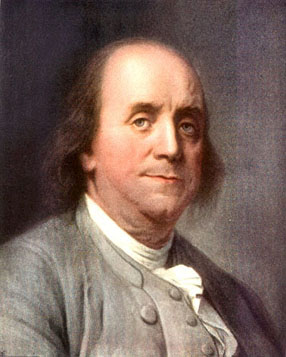
His career covered an amazing breadth of subjects, but he is perhaps best known for his work discovering electricity (the famous kite experiment), and also for his efforts to bring France into the War for Independence. Popular with many influential French thinkers, Franklin was dispatched to gain support for the cause. In many ways, it was Franklin's efforts to secure French loans that kept the Continental Army in the field. Franklin, along with John Adams and John Jay, would go on to negotiate the Treaty of Paris that ended the Revolutionary War.

To future generations, Franklin is an icon of the Revolutionary period. During his lifetime, however, he was far more popular with the crowns of Europe than he was with the leadership of the Colonies. John Adams, whom he had collaborated with on the Declaration of Independence and later in France, absolutely loathed the man. He would complain that his own role in the Revolution will be forgotten in favor of Franklin, he would write: "The essence of the whole will be that Dr. Franklin's electrical rod smote the earth and out sprang General Washington. That Franklin electrified him with his rod - and thenceforward these two conducted all the policies, negotiations, legislatures, and war."

Though not quite accurate, Adams was correct that the average American would always cherish the memory of Franklin. His funeral was attended by 20,000 people who crowded around the church to say goodbye. To this day, thousands of people visit his simple grave in Philadelphia, and toss pennies onto the tombstone of the man who advised a young nation that "a penny saved is a penny earned".

this post by Tom Haynes

Read More...

Saturday, March 29, 2008

John Adams on Ben Franklin - French Fried

HBO brought to life the pageantry and showiness of 18th Century France, with all its pomp and formalities. A far cry from the brash nature of John Adams and his more simple life from Braintree, Massachusetts. Suffice it to say, Adams was out of place in Paris. He himself said that he was unsuitably "accoutered" to be in the company of such opulence.

Sent to France, with Benjamin Franklin, to present to Louis XVI a proposition of a treaty to defeat the British together, Adams often felt as if he was alone in this endeavor.

"The longer I live in Europe and the more I consider our affairs, the more important our alliance with France appears to me", Adams wrote in his diary. Though upon his arrival, as alluded to in HBO's series, to his astonishment France and the United States had already formed an alliance. It was after the victory at Saratoga that France agreed that this fight was winnable and agreed that...


"If War should break out between France and Great Britain, during the continuance of the present War between the United States and England, his Majesty and the said united States, shall make it a common cause, and aid each other mutually with their good Offices, their Counsels, and their forces, according to the exigence of Conjunctures as becomes good & faithful Allies"
By the way... exigence means: the condition of being in need of immediate assistance. I had no idea what it meant, and had to look it up myself.

(here is the full text of the agreement: http://www.yale.edu/lawweb/avalon/diplomacy/france/fr1788-2.htm#art2)

This agreement was signed February 6, 1778, before Adams even left the shores Boston. Word travels slow across the ocean, which caused a communication problem during Adams' entire tenure. It was nearly impossible to stay abreast on the war at home and word from congress, forcing Adams and Franklin to make uninformed decisions.

From David McCullough's book John AdamsJohn Adams by David McCullough:

"There was no news from Congress, no news of the war at home, which was a formidable a problem as any. Dispatches from Philadelphia that evaded capture at sea took at least six weeks to reach Paris under ideal sailing conditions. The great distance separating America from Europe, the inevitable long delay in any communications with Congress, or worse, the complete lack of communication for months at a stretch, would plaque both Franklin and Adams their whole time in Europe, and put them at a decided disadvantage in dealing with European ministers, who maintained far closer, more efficient contact."
Thus, an answer from an inquiry sent from Franklin, Adams or Arthur Lee (brother of Virginia's great Richard Henry Lee) the third commissioner sent by Congress, could take 6 months.

Arthur Lee's presence added to the burden Adams felt in completing his mission. Lee, he believed, was unqualified for the post and added to the aggravation of the situation because of he was distrusted and disliked by the French. Additionally, Lee had learned to dislike Franklin during his days in London, and found it difficult to serve under Franklin, refusing to share quarters with him as well.

Adams, an advocate of efficiency and order, believed that the presence of he and Lee were gratuitous and that Franklin, and his good standing relationship with the French would suffice for America's cause.

Thinking his attendance unnecessary and feeling out of place, Adams was frustrated with the entire situation and expressed his feelings in a letter to his cousin, Samuel Adams:

"Between you and me, I have a difficult task. I am between two gentlemen of opposite tempers. The one may be too easy and good natured upon some occasions, the other too rigid and severe upon some occasions. The one may perhaps overlook an instance of roguery, from inadvertence and too much confidence. The other may mistake an instance of integrity for its opposite... Yet both may be and I believe are honest men, and devoted friends to their country. But this is an ugly situation for me who does not abound in philosophy and who cannot and will not trim. The consequence of it may very probably be that I may have the entire confidence of neither. Yet I have hitherto lived in friendship with both."

What Adams is referring to is the fact that Lee believed everybody was a spy, and Franklin, on the other hand, ignorantly gave information for many years to Dr. Edward Bancroft, a New England physician who was commissioned by the Crown for 500 pounds/year. Franklin befriended Bancroft, and according to Adams, out of pure laziness left too many decisions to Bancroft and Jacques Donatien Le Ray, the Comte de Chaumont. Chaumont was a wealthy Government contractor, who allowed Adams and Franklin to stay at his gracious garden estate. It was about one hour's ride to the King at Versailles.

Ben Franklin playing the part of rustic, Pennsylvania backwoods quaker to the amusement of FranceFranklin's aloofness furthered the tension between he and Adams. Though what Franklin lacked in awareness, he made up for with his respect from the French people.
Franklin was kind of a celebrity, and was loved by the French for his American rusticness. Franklin took his diplomatic duties seriously and exaggerated his homespun image by wearing a fur hat (seen left) and simply allowing his hair to grow long, and not opting for a powdered wig, which was the acceptable fashion at the time.

The French viewed Franklin as an inventive scientist from the backwoods of Pennsylvania often mistaken for being a Quaker. And because it made him more likable, he did nothing to reveal the truth.

Franklin was indeed the perfect diplomat to France. He was well liked and was able to frolic amongst the fancily-clad French, and considering his intelligence, his support of independence and assuming proper orders from Congress, could have done the job himself. Adams on the other hand, didn't fit in and was forced to assimilate to the French culture before becoming comfortable in his role. This is why Adams felt his services were not needed and would have rather fought for the Continental Army.
It was here that Adams' thoughts on Franklin began to change. I'll save his opinions for another post.

Read More...

Tuesday, March 25, 2008

John Adams Miniseries- Part 2 - Independence

Just some quick thoughts on Part 2 of the HBO miniseries. HBO did run this back to back with Part 1 last week, luring people with the excitement of 2 full hours of drama.

Part 2, entitled Independence, picks up at the First Continental Congress. I'm paralleling my reading of McCullough's John Adams with the mini-series and notice that HBO has decided to take what Adams wrote in his journals and use it in the dialog in Adams' conversations. It's a much better strategy than that of a voice over, which to me can be a distraction.

Once again, many great events in American history are referenced and not highlighted, and for good reason. It must be noted that these are the trials and tribulations of John Adams and not an overview of the Revolution, and thus Lexington and Concord warrants only a mention in passing. So if you're wondering when you're going to see George Washington at Valley Forge, you won't.. but pay attention, it is alluded to.

Ben Franklin, John Adams and Thomas Jefferson reading the Declaration of IndependenceAnother observation I found curious was the editing of Jefferson's version of the Declaration of Independence. In the past, I've seen it as being picked apart by many of the Delegates in front of the entire Congress. Director, Tom Hooper, has decided that it was edited in private by Adams, Ben Franklin and Jefferson at Jefferson's apartment. Like the image to the left. This idea would fit to be more realistic as it was a document that had not yet been presented in any way, shape or form to the Congress, and it would seem that it should be perfected before doing so.

The final vote for Independence, which required a unanimous decision was very well done, though not as dramatic as the one I'm more familiar with in the musical 1776. But on that note, the reading of the Declaration of Independence is effectively passionate, as it starts with John Hancock, President of the Congress, and moves to Adams' daughter reading amongst Abigail and her siblings, and then to an assembly in front of the Pennsylvania State House (now known as Independence Hall).

The voting and the reading of the Declaration of Independence can be effective if shown in class. Especially if followed with 'The Price They Paid', which is a reading about what happened to the 56 delegates after signing the Declaration. I also challenged my students to take it even a step further to see if they could prove if all the stories about the Delegates were true. They're not all true... See for yourself.

Read More...

Monday, July 23, 2007

The Postal System:

On July 26, 1775 the Second Continental Congress established the postal system. Yes, this is the same Continental Congress who deliberated and debated about independence from Britain.


With the revolutionary war in full swing communication was vital to the success of the United States. Congress needed to find a way to expediently relay information to and from the army.

The delegates to decided to put Ben Franklin in charge of the postal system.

The delivery of the mail at this time was not an easy task. Cities and towns were few and far between and were often separated by dense forests. The mail was rarely delivered successfully and was often times returned.

Franklin's efforts however, did bring the nation together and it worked well enough that the United States decided to keep it, even after the war. It has been running ever since...

"Neither snow nor rain nor heat nor gloom of night...stays these couriers from the swift completion of their appointed rounds."

Read More...