Friday, May 16, 2008

US History in Song

I found this song a few months ago when spending some time on YouTube.

The song, US History, by Flipsyde is a representation of the history of the United States as seen through the eyes of a personified America.

After discovering this song, I decided to check out a few more songs by Flipsyde. What I found was inspiring. Their songs are inspirational, educational, relevant and all send a positive message.

For teachers looking to use this song in class, I do recommend it, but be aware of the language. You might want to run this by the powers that be, or just be sure that your class is mature enough to except the song for what you're using it for... a history lesson.

I apologize in advance if the language offends anyone. It is for educational purposes.

It's got references to the mistreatment of Native Americans, The Revolution, The Civil War and slavery, imperialism, Teddy Roosevelt, The World Wars, including Pearl Harbor and the Atom bomb, Vietnam, the Cold War, Korean War, War in Iraq, etc... etc...

It really is impressive when you look at it from the standpoint of simplifying complex ideas and relationships in US History. If I were teaching US History right now... I'd use it.

Watch the video... then listen to the song again and read the lyrics. And tell me what you think...


US History - by Flipsyde

Hustlin's in my blood my father's name is Britain
His history consisted of robbery killin' and pimpin

Filthy rich and the biggest killer that you ever seen
Once I'm older I'm takin' over I'ma be king

I was locked up in jail when he got the new land
Opened his cells I guess that's how the story began

First mission was to clear it out and claim it as mine
Indigenous people were peaceful it took no time

Great grandmother Africa was blind and disabled
Sons was traitors we played divide and conquer invaded

Sold her children into slavery and profited quick
Started makin' side deals and that's how I got rich

Daddy Britain found out and tried to put me in check
He don't understand I'm a man and I deserve some respect

Tried to bring it to me but I play for keeps and I won
Still my daddy but you ain't the only man with a gun

More money More problems little brother is wild
They call 'em The South he's country with a big ass mouth

Tried to show 'em new business but he don't wanna change
I love 'em but I knew eventually I'd blow out his brains

I'm America!

You know you know God Bless America
You know you know God Bless

Me and my daddy still cool and my uncles is with us
France Russia and Italy and we all killas

But it's this nigga named Germany that's out of control
Rollin with Japan and Turkey and them niggas is bold

Started fuckin' with my uncles and we all went to war
Uncle France damn near died at the tip of his sword

When the smoke cleared we won let 'em retreat
Shoulda' killed 'em cause they knew they had us close to defeat

Kicked it off again 20 years later it was on
This time my uncle Italy traded and he was gone

I was neutral when Japan hit me guess that he knew
I aint gone' let my family fight without me jumpin' in too

Woulda' lost if I didn't hit Germany's weapon supply
Kamikaze Japanese was always ready to die

Dropped atomic bomb let them niggas know that it's real
Speak soft with a big stick do what I say or be killed

I'm America!

You know you know God Bless America
You know you know God Bless

I'm racin' with my uncle Russia we the ones with the guns
He supported the North so I rolled with South Vietnam

Thought it would be easy but almost 60 thousand died
They was harder than Korea so we ran for our lives

It's a family called the Middle East and they got bread
Sellin' oil they don't cut me in then off with their head

I got a nephew named Israel that's right in the middle
Pay his allowance as long as he can dance to my fiddle

I had a partna' named Iraq gave 'em weapons and money
Nigga started getting' power and he start actin' funny

Saudi Arabia's cool gotta son Bin Laden
I was trainin' his soldiers to go against the Russians and stop 'em

Then he tried to say I need to take my soldiers and cut
Gave 'em the finger that's when he flipped and blew my shit up

I took it to 'em, and then I took it back to Iraq
and if you ain't my blood brother you gonna be flat on yo' back

The sons of Africa just invented this shit called rap
Tellin' my secrets that's why I'm puttin' their heads on flat

Built an empire quick and it might not last
But I bet I go down in history as the one that smashed

I'm America!

You know you know God Bless America
You know you know God Bless

Hustlin's in my blood my father's name is Britain

The red the white the red the white the blue

Saturday, May 10, 2008

Survey Results: Who is the Best President since 1950?

Put down your pencils. The polls are now closed.


The readers of USHistorySite.Blogspot.com have spoken... the best President since 1950 (from the choices given) is... William Jefferson Clinton.

This is Clinton's first Survey Victory and came as kind of a surprise to me. With 33% percent of the vote he narrowly edged out Ronald Reagan who received 29% of the vote.

Here are the full results after 72 votes:

Harry Truman - 11% (8 votes)
Dwight D. Eisenhower - 5% (4 votes)
John F. Kennedy - 20% (15 votes)
Ronald Reagan - 29% (21 votes)
Bill Clinton - 33% (24 votes)

Despite his impeachment trial, in 1998 and 1999, Clinton's approval rating still ranked among the best in history at 73%. He ended his term with an approval rating of 68%. And according to Wikipedia, (I know... not the most reliable source) his final rating is higher than that of any other departing president since approval ratings began more than seventy years earlier.

Why was his approval so high?

How about 8 years of relative peace and prosperity. A good economy leaves people happy. Nobody can doubt his intelligence, and how he used his intelligence to be the best fiscal leader we've had in a long, long time. This rationale could be the same reason Ronald Reagan ranked so high.

Thank you to all who contributed, and more importantly to those that commented and opened up a dialogue. I'd like to hear from more of you concerning the results. Does this surprise you?

To get it started - here is my grandfather's reaction
I just reviewed your survey. It seems to me that the answers were progressive. By that I mean young people with very little knowledge of past history voted the current appeal.They knew little or nothing of Truman and Eisenhower. I wouldn't say IKE was a good President,but he could have run on any ticket and been elected. He was that popular.It would be the same for Colin Powell. It's unfortunate that we are faced with our present dilemma. The good ones don't have national appeal and the ones with national appeal are awful. They are supported by young liberals who would have been better to serve Army time to open their eyes. GP
I welcome thoughts on GPs comments as well...

Wednesday, May 07, 2008

History Goes Viral: Teddy Roosevelt on Immigrants

This came across my email this week. It was urged that I pass it on to every American with a computer. I didn't... but I do share it with you.


'In the first place, we should insist that if the immigrant who comes here in good faith becomes an American and assimilates himself to us, he shall be treated on an exact equality with everyone else, for it is an outrage to discriminate against any such man because of creed, or birthplace, or origin. But this is predicated upon the person's becoming in every facet an American, and nothing but an American...There can be no divided allegiance here. Any man who says he is an American, but something else also, isn't an American at all. We have room for but one flag, the American flag... We have room for but one language here, and that is the English language... and we have room for but one sole loyalty and that is a loyalty to the American people.'
- Theodore Roosevelt 1907
It is difficult to put our 2008 minds back to 1907. But we can try....

What are your thoughts on what Roosevelt is saying?

Free Advertising on my sister site USHistorySite.com on the Teddy Roosevelt page (for 1 year)for the best comment/interpretation of what Roosevelt is saying... I'll pick a winner in a week.


Friday, May 02, 2008

May 2, 1939: Lou Gehrig "The Iron Horse" Ends the Streak

Lou Gehrig of the New York Yankees played in 2130 games a major league record that would stand for 56 yearsLou Gehrig was a man of consistency. In 17 Major League seasons he wracked up a .340 batting average, hit 493 homeruns and collected 1,995 RBIs. In the 16 years preceding the 1939 season, Gehrig averaged 38 homeruns and 150 RBIs.

But through the first 8 games of the 1939 season, Gehrig batted .143 with 1 RBI. The poor start was inconsistent with the true Lou Gehrig. Thus, on May 2, 1939 Gehrig voluntarily benches himself "for the good of the team." Gehrig did make one quick appearance during the game, when he brough the Yankees lineup out to the umpire... but ultimately, his consecutive-game streak was halted at 2,130 games.

Though he didn't know it at the time, Gehrig had contracted amyotrophic lateral sclerosis (ALS, aka Lou Gehrig's Disease). Gehrig's streak would stand for another 56 years. On September 6, 1995, Cal Ripken Jr. played in his 2,131st consecutive game. Ripken would go on to play in an unprecedented 2,632 consecutive games, before he too benched himself for the good of the team.

May 2, 1939, will forever be the day when Gehrig "hung 'em up." Two month's later, on July 4, Gehrig would make his famous Farewell speech at Yankee Stadium. Full text of the speech is below. (Hollywood echo, not included...)

"Fans, for the past two weeks you have been reading about the bad break I got. Yet today I consider myself the luckiest man on the face of this earth. I have been in ballparks for seventeen years and have never received anything but kindness and encouragement from you fans.

"Look at these grand men. Which of you wouldn't consider it the highlight of his career just to associate with them for even one day? Sure, I'm lucky. Who wouldn't consider it an honor to have known Jacob Ruppert? Also, the builder of baseball's greatest empire, Ed Barrow? To have spent six years with that wonderful little fellow, Miller Huggins? Then to have spent the next nine years with that outstanding leader, that smart student of psychology, the best manager in baseball today, Joe McCarthy? Sure, I'm lucky.

"When the New York Giants, a team you would give your right arm to beat, and vice versa, sends you a gift - that's something. When everybody down to the groundskeepers and those boys in white coats remember you with trophies - that's something. When you have a wonderful mother-in-law who takes sides with you in squabbles with her own daughter - that's something. When you have a father and a mother who work all their lives so you can have an education and build your body - it's a blessing. When you have a wife who has been a tower of strength and shown more courage than you dreamed existed - that's the finest I know.

"So I close in saying that I may have had a tough break, but I have an awful lot to live for."

For an audi version of the speech and to find more information, visit the official Lou Gehrig website: http://www.lougehrig.com/

Saturday, April 26, 2008

Ulysses S. Grant Born... and Born Again...

On April 27 1822, famed Civil War General and 18th President of the United States Ulysses S. Grant was born.


Grant, better known for his prowess on the battlefield as opposed to his leadership in office is a neat character. He quickly rose his way to the top of the Union Army after having sat "fallow" for some time before the war.

Fallow -- land, plowed and left unseeded for a season or more; uncultivated; not in use.

After some action in the Mexican-American(1846-1848) War and preceding the Civil War (1861), Grant sat "fallow" for several years while trying his hand at farming. He failed. In fact, he tried many different occupations and wasn't good at any of them.

This is what makes his quick rise in to leadership with the Union Army so interesting. With very little military leadership training, Grant simply won battle after battle. His secret was simple. Other leaders spent much of their time trying to outsmart their counterpart, worrying what the other would do. Not Grant. Grant didn't worry about his opposition and simply did what he thought was best. He didn't care what his opponent was doing. It seemed to work.
After serving as President, Grant died a poor man. His last years were spent writing his memoirs, of which he never saw a penny. Though his surviving wife was able to profit from his writings.

Ulysses S. Grant on the new colored $50 fifty dollar billIn 2004, US Grant was born again. April 26, 2004 the United States introduced the new colored $50 bill. The new design was put in place to deter counterfeiters. It was the first design change for the fifty since 1997.
Fun Facts:
In 2005, US Representative John Kline introduced legislation to replace Grant's image on the $50 bill with an image of President Ronald Reagan.
Grant had owned one slave whom he set free in 1859.

Thursday, April 17, 2008

Who is the Best President since 1950?

I was in New Orleans for a few days on business. Learned a bit about the history of NOLA, did some work with Habitat for Humanity, putting on siding for Charles (the home owner) in the Upper 9th Ward (one of the most devestaded areas), spent some time at a conference, strolled Bourbon Street and bought a book about the Battle of New Orleans from a bookshop where William Faulkner used to live. A good week for site seeing, but a bad week for posts.


That said, I've added a new USHistorySite Survey...

The question is: Who is the Best President since 1950?

Harry Truman
Dwight D. Eisenhower
John F. Kennedy
Ronald Reagan
Bill Clinton

You can find it in the margin on the right. I'll leave it up until I get 50 votes or more...

Let me know your comments after you vote? Why did you choose JFK? Tell me why you think Carter should have made the list. Is Bill Clinton deserving? The forum is now open...

Thursday, April 10, 2008

Survey Results: You Have a Time Machine. Who would you like to meet?

Teddy Roosevelt wins the first USHistorySite surveyThe results are in from the first USHistorySite Survey... after 50 votes, Teddy Roosevelt is our winner taking 44% of the vote.


You Have a Time Machine: Who Would You Like to Meet?
John Adams - 10% (5 votes)
Teddy Roosevelt - 44% (22 votes)
Abraham Lincoln15 - 30% (15 votes)
George Washington8 - 16% (8 votes)

It's not a surprise. Teddy Roosevelt is like able. He's a guy's guy. Of the 4 listed, he's probably the one I'd most like to have a beer with. Not that I wouldn't want to meet all of them, it's just that Teddy seems to be rowdy ol' chap, who could probably spin a good yarn, and put 'em down with the best of 'em.

Lincoln, and his self-deprecating stories, and his sense of humor, is something I'd enjoy too. But Lincoln, to me, is more of a guy who would have you over his house for dinner and then tell stories after retiring to the living room. That would be fun too.

Washington is still kind of enigma to me. I know that he liked to associate in high circles, and then he'd rarely if ever hang out with someone of a lower cloth. He was an American aristocrat. I wish I knew more about Washington. He'll probably be my next focus of study, as I've always felt that he wasn't much of a personality, but one who lead with his presence. I silent, thoughtful leader.

Adams is a hard worker. His Boston brethren, to this day, still follow him and his 'blue collar' work ethic. If you're on his good side, he's a great friend. He stands up for what he believes, but is a little awkward in social situations. He's known for being 'obnoxious and disliked'.

Congratulations to Teddy Roosevelt for being the first winner in the USHistorySite Survey. Thank you to all that participated.

The lines are now open for suggestions for the next survey.

Sunday, April 06, 2008

Meeting David Wilson: Slave Owning Family Meets Enslaved Counterpart

Though they've never met... they share the same name. Their ancestors knew each other. They lived on the same property... One was a slave... the other, the slave owner.

Coinciding with the 40th anniversary of the MLK's death, MSNBC will present "Meeting David Wilson". The documentary premieres April 11th.

One David Wilson is an African-American who grew up in the tough streets of Newark, New Jersey and now works as a television news producer in New York City. The other, a 62-year-old white man, living in rural North Carolina, runs a chain of BBQ restaurants, not too far from where his ancestors farmed tobacco.

The two men will meet face-to-face in the strangest of "family reunions". I think this idea is very creative. I'm looking forward to seeing how this turns out. Though the previews are making it seem as if there might be some drama between the two men and their storied pasts, I for one don't think there will be much.

There will definitely be some story swapping and some interesting dialogue, but I'm not expecting fireworks. I'm hoping they reveal enough background on the families to show how they've developed to where they are today. I'm curious to see the different paths of two families. One, living off the riches from tobacco. The other, making their way north, eventually to New Jersey, to build on what little foundation they had in the antebellum South.

NBC News president Steve Capus believes that the documentary will "open the dialogue, encourage better understanding of the issues, and, hopefully, shine new light on the current state of race relations in our country today."

The video below, from the David Wilson MySpace page, is a pretty good indication of what Capus is referencing above. There needs to be a dialogue. There needs to be communication. We, both black and white, still have our prejudices against the other. We both have our issues with the current race situation, and I don't think we truly realize what the other is experiencing. I'm one to believe that we are still in the "reconstruction" from the effects of the Civil War, and all that was involved with it.

Sure, there are opportunities for all races at all socio-economic status levels, but the opportunities are tougher to come by for some.


Go to MSNBC for the full story.
http://www.msnbc.msn.com/id/23760280/

Official David Wilson Web site:
http://meetingdavidwilson.com/

Attention Teachers: I'm a bit disappointed that MeetingDavidWilson.com does not have lesson plans readily available to use with this documentary. I'm surprised because we all know, many of you out there will be recoding this and showing it in class the next day. The documentary enough, is probably enough to just have a class discussion, wrapped around the question posed by Davide Wilsson himself... "What's wrong with black people? And why we had to ask."

But if you do use this in class, please share your ideas, and post them here so that we can continue this dialogue.

Wednesday, April 02, 2008

One Man: The Death of Martin Luther King - April 4, 1968

Early morning, April 4
Shot rings out in the Memphis sky
Free at last, they took your life
They could not take your pride

- Pride, U2

April 4, 1968, will be a day that will forever be a day of mourning. A day when one of the bravest men to ever walk the face of the earth, was taken years before his time.

The night before King made his "I've been to the mountain top" speech where his prophetic words came true all too soon...

"I've seen the promised land. I may not get there with you. But I want you to know tonight, that we, as a people, will get to the promised land. "

Six years later on the same day, Hank Aaron helped to reach that promised land. April 4, 1974, on Major League Baseball's opening day, Hank Aaron hit homerun number 714, tying him with Babe Ruth for the all time record.

Hank Aaron was now at the top of the mountain. Hank Aaron now saw the promised land. Like King, he persevered through racism, name calling, eating on the bus as opposed to in the restaurants with the rest of the team. Sleeping in separate hotels. He overcame death threats and threats of harming his family. Hank Aaron overcame and was on top of that mountain. Aaron would eventually reach that promised land. Hank Aaron would go on to hit 41 more homeruns. His 755 homeruns were the most in major league history. His record stood for 34 years, until Barry Bonds broke the record in 2007.

Here is a timeline of Hank Aaron's tumultuous homerun chase: http://www.sportingnews.com/archives/aaron/timeline.html

Martin Luther King would have been proud of Hank Aaron. And Martin Luther King is the epitome of PRIDE.

I present to you a tribute to Dr. King, using U2's "Pride". I encourage you to watch the video and listen to the lyrics. I've included them in their entirety below.

In Memoriam: Dr. Martin Luther King
January 15, 1929 - April 4, 1968


U2 - Pride (In the Name of Love) -

One man come in the name of love
One man come and go
One come he to justify
One man to overthrow

In the name of love
What more in the name of love
In the name of love
What more in the name of love

One man caught on a barbed wire fence
One man he resist
One man washed on an empty beach.
One man betrayed with a kiss

In the name of love
What more in the name of love
In the name of love
What more in the name of love

(nobody like you...)

Early morning, April 4
Shot rings out in the Memphis sky
Free at last, they took your life
They could not take your pride

In the name of love
What more in the name of love
In the name of love
What more in the name of love

In the name of love
What more in the name of love...

One Man: Martin Luther King's 'Mountain Top' Speech

One man come in the name of love
One man come and go
One man come, he to justify
One man to overthrow

- Pride, U2

It was on this day, April 3, 1968 - when Martin Luther King made his famous Mountain Top speech. It was a speech about determination, perserverence and bravery. It was a speech where King, imagines that he is granted the ability to live in any era in history. He imagines himself with Moses in Eqypt parting the Red Sea and with Roman leaders. He dreams of being in the midst of the reneissance or with Abraham Lincoln at the signing of the Emancipation Proclamation. But finally, he concludes, he'd ask "the Almighty" for the ability "to live just a few years in the second half of the twentieth century". If he's given this, he'd be happy.

King goes on to the conclude his speech with the following prophetic lines:


Like anybody, I would like to live a long life. Longevity has its place. But I'm not concerned about that now. I just want to do God's will. And He's allowed me to go up to the mountain. And I've looked over. And I've seen the promised land. I may not get there with you. But I want you to know tonight, that we, as a people, will get to the promised land. So I'm happy, tonight. I'm not worried about anything. I'm not fearing any man. Mine eyes have seen the glory of the coming of the Lord.
Little did he know, these words would be his last. King was shot and killed the next morning.


Here's a link to the entire transcription of Martin Luther King's "I've Been to the Mountain Top" Speech - http://www.afscme.org/about/1549.cfm

Saturday, March 29, 2008

John Adams on Ben Franklin - French Fried

HBO brought to life the pageantry and showiness of 18th Century France, with all its pomp and formalities. A far cry from the brash nature of John Adams and his more simple life from Braintree, Massachusetts. Suffice it to say, Adams was out of place in Paris. He himself said that he was unsuitably "accoutered" to be in the company of such opulence.

Sent to France, with Benjamin Franklin, to present to Louis XVI a proposition of a treaty to defeat the British together, Adams often felt as if he was alone in this endeavor.

"The longer I live in Europe and the more I consider our affairs, the more important our alliance with France appears to me", Adams wrote in his diary. Though upon his arrival, as alluded to in HBO's series, to his astonishment France and the United States had already formed an alliance. It was after the victory at Saratoga that France agreed that this fight was winnable and agreed that...


"If War should break out between France and Great Britain, during the continuance of the present War between the United States and England, his Majesty and the said united States, shall make it a common cause, and aid each other mutually with their good Offices, their Counsels, and their forces, according to the exigence of Conjunctures as becomes good & faithful Allies"
By the way... exigence means: the condition of being in need of immediate assistance. I had no idea what it meant, and had to look it up myself.

(here is the full text of the agreement: http://www.yale.edu/lawweb/avalon/diplomacy/france/fr1788-2.htm#art2)

This agreement was signed February 6, 1778, before Adams even left the shores Boston. Word travels slow across the ocean, which caused a communication problem during Adams' entire tenure. It was nearly impossible to stay abreast on the war at home and word from congress, forcing Adams and Franklin to make uninformed decisions.

From David McCullough's book John AdamsJohn Adams by David McCullough:

"There was no news from Congress, no news of the war at home, which was a formidable a problem as any. Dispatches from Philadelphia that evaded capture at sea took at least six weeks to reach Paris under ideal sailing conditions. The great distance separating America from Europe, the inevitable long delay in any communications with Congress, or worse, the complete lack of communication for months at a stretch, would plaque both Franklin and Adams their whole time in Europe, and put them at a decided disadvantage in dealing with European ministers, who maintained far closer, more efficient contact."
Thus, an answer from an inquiry sent from Franklin, Adams or Arthur Lee (brother of Virginia's great Richard Henry Lee) the third commissioner sent by Congress, could take 6 months.

Arthur Lee's presence added to the burden Adams felt in completing his mission. Lee, he believed, was unqualified for the post and added to the aggravation of the situation because of he was distrusted and disliked by the French. Additionally, Lee had learned to dislike Franklin during his days in London, and found it difficult to serve under Franklin, refusing to share quarters with him as well.

Adams, an advocate of efficiency and order, believed that the presence of he and Lee were gratuitous and that Franklin, and his good standing relationship with the French would suffice for America's cause.

Thinking his attendance unnecessary and feeling out of place, Adams was frustrated with the entire situation and expressed his feelings in a letter to his cousin, Samuel Adams:

"Between you and me, I have a difficult task. I am between two gentlemen of opposite tempers. The one may be too easy and good natured upon some occasions, the other too rigid and severe upon some occasions. The one may perhaps overlook an instance of roguery, from inadvertence and too much confidence. The other may mistake an instance of integrity for its opposite... Yet both may be and I believe are honest men, and devoted friends to their country. But this is an ugly situation for me who does not abound in philosophy and who cannot and will not trim. The consequence of it may very probably be that I may have the entire confidence of neither. Yet I have hitherto lived in friendship with both."

What Adams is referring to is the fact that Lee believed everybody was a spy, and Franklin, on the other hand, ignorantly gave information for many years to Dr. Edward Bancroft, a New England physician who was commissioned by the Crown for 500 pounds/year. Franklin befriended Bancroft, and according to Adams, out of pure laziness left too many decisions to Bancroft and Jacques Donatien Le Ray, the Comte de Chaumont. Chaumont was a wealthy Government contractor, who allowed Adams and Franklin to stay at his gracious garden estate. It was about one hour's ride to the King at Versailles.

Ben Franklin playing the part of rustic, Pennsylvania backwoods quaker to the amusement of FranceFranklin's aloofness furthered the tension between he and Adams. Though what Franklin lacked in awareness, he made up for with his respect from the French people.
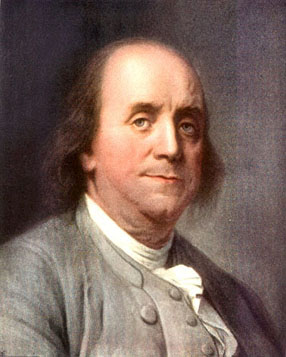
Franklin was kind of a celebrity, and was loved by the French for his American rusticness. Franklin took his diplomatic duties seriously and exaggerated his homespun image by wearing a fur hat (seen left) and simply allowing his hair to grow long, and not opting for a powdered wig, which was the acceptable fashion at the time.

The French viewed Franklin as an inventive scientist from the backwoods of Pennsylvania often mistaken for being a Quaker. And because it made him more likable, he did nothing to reveal the truth.

Franklin was indeed the perfect diplomat to France. He was well liked and was able to frolic amongst the fancily-clad French, and considering his intelligence, his support of independence and assuming proper orders from Congress, could have done the job himself. Adams on the other hand, didn't fit in and was forced to assimilate to the French culture before becoming comfortable in his role. This is why Adams felt his services were not needed and would have rather fought for the Continental Army.
It was here that Adams' thoughts on Franklin began to change. I'll save his opinions for another post.

Tuesday, March 25, 2008

John Adams Miniseries- Part 2 - Independence

Just some quick thoughts on Part 2 of the HBO miniseries. HBO did run this back to back with Part 1 last week, luring people with the excitement of 2 full hours of drama.

Part 2, entitled Independence, picks up at the First Continental Congress. I'm paralleling my reading of McCullough's John Adams with the mini-series and notice that HBO has decided to take what Adams wrote in his journals and use it in the dialog in Adams' conversations. It's a much better strategy than that of a voice over, which to me can be a distraction.

Once again, many great events in American history are referenced and not highlighted, and for good reason. It must be noted that these are the trials and tribulations of John Adams and not an overview of the Revolution, and thus Lexington and Concord warrants only a mention in passing. So if you're wondering when you're going to see George Washington at Valley Forge, you won't.. but pay attention, it is alluded to.

Ben Franklin, John Adams and Thomas Jefferson reading the Declaration of IndependenceAnother observation I found curious was the editing of Jefferson's version of the Declaration of Independence. In the past, I've seen it as being picked apart by many of the Delegates in front of the entire Congress. Director, Tom Hooper, has decided that it was edited in private by Adams, Ben Franklin and Jefferson at Jefferson's apartment. Like the image to the left. This idea would fit to be more realistic as it was a document that had not yet been presented in any way, shape or form to the Congress, and it would seem that it should be perfected before doing so.

The final vote for Independence, which required a unanimous decision was very well done, though not as dramatic as the one I'm more familiar with in the musical 1776. But on that note, the reading of the Declaration of Independence is effectively passionate, as it starts with John Hancock, President of the Congress, and moves to Adams' daughter reading amongst Abigail and her siblings, and then to an assembly in front of the Pennsylvania State House (now known as Independence Hall).

The voting and the reading of the Declaration of Independence can be effective if shown in class. Especially if followed with 'The Price They Paid', which is a reading about what happened to the 56 delegates after signing the Declaration. I also challenged my students to take it even a step further to see if they could prove if all the stories about the Delegates were true. They're not all true... See for yourself.

Tuesday, March 18, 2008

John Adams Mini Series - Part 1 - Join or Die

Giamatti and Laura Linney as John and Abigail Adams in HBO's John Adams miniseriesHBO's John Adams debuted Sunday night, and I must say I was impressed. I worked with Comcast to finagle HBO for free for a 6 months. I had to buy all the channels in the 100s to do so, but I worked that to only be $4/month, and it includes the Do It Yourself (DIY) Network, which is well worth the $4 alone. All it took was to say NO to their first 3 offers.

Though I don't encourage showing an unguided movie in class, I do encourage the use of a film like John Adams to enhance the learning. That said, Part 1, entitled 'Join or Die' contains an excellent portrayal of the Boston Massacre and all of the indecision and doubt that surrounded the trial. For about minutes, HBO took you through the "riot", the reaction from the Colony, the decision for Adams to defend Captain Preston and the soldiers and finally the trial.

Done succinctly and with very little off topic tangents, it would be of good use in a US History class discussing the Boston Massacre and how it catapulted Adams into the spotlight and further ripped the seam between the Colonies and the King. It would also serve the purpose of a government class, exemplifying the "innocent until proven guilty" mantra as well as the emphasis of "facts and evidence" as clearly stated by Adams.

In addition to the Boston Massacre, part 1 alludes to the Boston Tea Party, the Intolerable Acts and concludes with Adams being selected to attend the First Continental Congress in Philadelphia.

Here is HBO's recap of episode one: http://www.hbo.com/films/johnadams/. It's cool and interactive. Heck, use this in class. Then show bits of the film. If you've got a DVD recorder show it now... it's for education... copyright? bahumbug!!!

Laura Linney is great and the guy who plays John Dickinson is impressive as well. George Washington, is played by the usually familiar face of David Morse (Green Mile, Hack), who incidentally was born in Massachusetts, Adam's "country".

If this film does anything it changes my perception of John Adams only in as much as how he looks and talks. I'm a big fan of the movie 1776, where Adams is portrayed brilliantly by William Daniels (aka Mr. Feeny from Boy Meets World, Dr. Craig from St. Elsewhere and of course... the voice of K.I.T.T from Knight Rider).

For your pleasure I've included an excerpt from 1776, to give you an idea of how I used to view John Adams... Paul Giamatti might just be good enough to change my mind. Can't wait for Sunday night.

Saturday, March 15, 2008

St. Patrick's Day - An American Tradition

March 17 marks the feast day of Ireland's patron saint, Patrick. St. Patrick (386-461), a cleric in the Catholic sense, is credited with banishing Ireland of snakes, even though Ireland never had snakes. Because of this, St. Patrick's day is an official holiday in Ireland, but it is celebrated informally worldwide by people of every ethnic background.

The first recorded celebration of St. Patrick's Day in the American Colonies was in Boston in 1737. These early celebrations were by men of wealth and means living in the colonies.

In the wake of American independence, many Irish Catholics from all walks of life were continuously lured to the United States with the promise of religious freedom. It was this movement that prompted St. Patrick's day to take on a more common man personae.

In 1827 restrictions on Irish emigration was lifted by Britain, and by 1835, more than 30,000 Irish immigrants were arriving in New York each year. These impoverished, uneducated immigrants established themselves quickly with their undying loyalty to their new country. The Irish came in droves and promptly joined the police and fire departments and railroad companies. To this day, many police officers, firemen, and railroad workers carry on the tradition of their forefathers by doing what their daddy did. Just look through the roster of any New York or Philadelphia police department or fire company and you'll see a plethora of Irish names.

As the number of Irish-Americans grew, so did the celebration of St. Patrick's day. Along wit hthis came the political power of the Irish communities in Boston, New York and Chicago. It was these political groups that helped get John Fitzgerald Kennedy, our nation's first and only Catholic President into office. This also explains the Boston Celtics and the Chicago River being dyed green during Chicago's St. Patrick's day celebration.

Many of the Irish in America used the March 17th celebrations as a platform for their American right of free speech. The 1970s brought a tone of political activism on St. Patrick's day with fundraising for Irish charities calling for the withdrawal of British occupancy in Northern Ireland. This brought the awareness of The Troubles in Northern Ireland to the United States.

For those that are unfamiliar with this conflict, Northern Ireland has been the site of a violent and bloody political conflict between Nationalist who want Northern Ireland to be part of the Irish Republic and the Unionists who wish to remain part of the United Kingdom.

Bono and Irish leaders during the Good Friday peace negotiationsThis activism is what prompted President Bill Clinton to invite those involved in the Irish conflict to Washington to negotiate peace, on St. Patrick's Day 1998. These talks resulted in the Good Friday Accord of April 10, 1998, which called for Protestants (Unionists) to share political power with the Catholics (Nationalists), and gave the Republic of Ireland a say in the affairs Northern Ireland.

And what would an Irish peace treaty be without Bono, pictured between David Trimble (left) and John Hume, respective leaders of Unionists and the Nationalists in a 1998 concer supporting the Good Friday agreement.

Clinton's action, is similar to the action's of Jimmy Carter at the Camp David Accords, where Muhammad Anwar al-Sadatand of Egypt and Menachin Begin of Israel were invited to Jimmy Carter's Camp David retreat to iron out their differences. The two countries did eventually find peace... here is the framework of that agreement.

PS - And here's a neat article on Green Beer, i.e. environmentally friendly breweries. Off the subject slightly, but worthy of a look-see.

Here's 1,001 Things Everyone Should Know About Irish American History and A History of the Irish in America. St. Patrick

And finally, here's a candid picture of Ronald Reagan celebrating St. Patrick's Day. For more pics of Ronald Reagan, go to http://www.reagan.utexas.edu/archives/photographs/candid.html


President Ronald Reagan on st. Patrick's day