The following information is courtesy of The Library of Congress (http://rs6.loc.gov/ammem/today/may07.html):
"On May 7, 1915, the German U-20 (submarine) sank the British ocean liner Lusitania. Approximately 1,200 civilians died; more than 100 were U.S. citizens.
In reply to President Woodrow Wilson's protest, Germany justified the attack on grounds that the British government intended to arm merchant ships. Prior to the Lusitania's departure, the German government had warned that ships entering the war zone could be fired upon.
The Lusitania carried both passengers and ammunition that had been manufactured in the United States. The incident illustrated the difficulty of maintaining American neutrality. Appalled at Wilson's willingness to criticize Germany while ignoring British transgressions, Secretary of State William Jennings Bryan resigned.
The sinking of the Lusitania also highlighted the changing nature of war. Traditional rules of naval engagement mandated warning commercial vessels before firing upon them. However, surfacing to do so would place a U-boat in grave danger of destruction.
Public outrage over the loss of American civilian life hastened the U.S. entry into World War I. Although the cargo list of the Lusitania stated that she carried approximately 170 tons of munitions and war material, this information was not revealed to the public at the time. "
The very fact that the information was not revealed to the public is cause for debate. This "white lie" allowed the United States to rid themselves of any wrongdoing and pin everything on the German. Propaganda posters of the Kaiser would soon follow.
Thursday, May 06, 2010
On This Day in US History: The Sinking of the Lusitania
Friday, May 01, 2009
This Day in U.S. History, May 1st.
On May 1st, 1960, Francis Gary Powers was shot down by Soviet Air Defenses while piloting his U-2 spy plane.
Flying from an airbase established in Pakistan, Powers was supposed to take pictures of several top-secret soviet facilities before landing in Norway. Unfortunately, the Soviets were aware of the flights and were prepared.
Their first attempts to bring the U-2 down were with MiG-19 fighters, with orders to bring it down by any means including ramming if necessary. Due to the extreme operating altitude of the spy plane, the MiG-19s were unable to engage but continued to chase it. Finally a salvo of surface-to-air missiles hit the aircraft and it began to descend. Powers bailed out just before a second salvo hit the aircraft and was captured. A pursuing MiG was brought down by friendly fire.
Initially, the United States tried to cover up the incident. NASA claimed one of their aircraft had gone missing, and a U-2 was given a NASA paintjob in an attempt to convince the press that it was operating these aircraft. The Soviets continued to tell the world (correctly) that they had shot down a spy-plane.
The Soviets made no mention that Francis Gary Powers had been captured, and then President Dwight D. Eisenhower assumed he had been killed (or had killed himself using poison he carried in a fake silver dollar to avoid capture). The White House issued a statement saying a weather research aircraft had lost its way and that "there was absolutely no deliberate attempt to violate Soviet airspace and never has been."
The White House had walked right into a trap, and Soviet Premier Nikita Khrushchev announced "I must tell you a secret. When I made my first report I deliberately did not say that the pilot was alive and well… and now just look how many silly things [the Americans] have said." Not only did they have Powers, but the Soviets had even managed to develop some of the film taken by the U-2's camera.
A very embarrassed White House was forced to acknowledge the spying missions, and Soviet-U.S. relationships deteriorated even further. Francis Gary Powers was convicted of espionage, and sentenced to three years of imprisonment followed by seven of hard labor. He was later exchanged for a captured soviet spy after serving 21 months of the sentence.
Thursday, April 30, 2009
This Day in U.S. History, April 30th.
On April 30, 1803, France sold Louisiana and the adjoining lands to the United States for $15 million dollars (78 million francs).
The Louisiana Purchase was a pivotal point in U.S. history for several reasons. First, it drastically increased the size of the young country…nearly doubling the territory the United States controlled. Second, it set an important precedent for the Federal government to expand the country.
The asking price was no great obstacle. The total price was partially covered by the cancelling of $3,250,000 worth of French debt held by the U.S., and after a $3 million down payment in gold, only about $9 million needed to be raised. With U.S. credit still recovering from the Revolutionary War it was, ironically, an English financial firm that backed the U.S. bonds used to raise the money.
It was this second reason that lead to the most opposition to the purchase. The Constitution made no mention of acquiring territory, and any power that was not expressly granted to the federal government was supposed to belong to the states. At a time when most state governments tended to think of themselves as almost separate countries, this was no trifling point. President Jefferson, president at the time, had been the greatest champion of state rights but pragmatism quickly overruled his philosophical leanings…hypocritical or not it was simply too good of a deal to pass up.
The territory acquired would eventually make up parts of 14 U.S. states and 2 Canadian provinces. The Louisiana Purchase accounts for 23% of the present-day United States. The modern day states of Arkansas, Colorado, Iowa, Kansas, Louisiana, Minnesota, Missouri, Montana, Nebraska, New Mexico, North Dakota, Oklahoma, South Dakota, and Wyoming, were acquired at least partially in the purchase (as were small pieces of modern day Canadian Provinces Alberta and Saskatchewan).
Friday, April 17, 2009
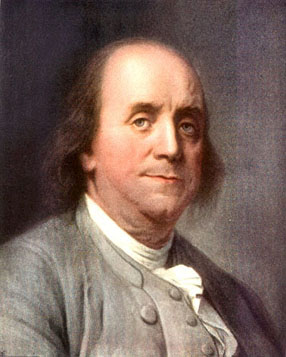
On This Day: April 17, 1790 - Ben Franklin Dies
On this day in 1790, the first American super-star died. Benjamin Franklin was the most accomplished American of his age, and perhaps any age. Franklin was successful in many areas, he was an accomplished author, printer, scientist, inventor, politician, and diplomat. In his spare time, he was a civic activist who founded one of the most influential libraries in the (then) colonies, reformed the U.S. postal system and laid the groundwork for the modern system, and created one of the first volunteer fire fighting companies.
His career covered an amazing breadth of subjects, but he is perhaps best known for his work discovering electricity (the famous kite experiment), and also for his efforts to bring France into the War for Independence. Popular with many influential French thinkers, Franklin was dispatched to gain support for the cause. In many ways, it was Franklin's efforts to secure French loans that kept the Continental Army in the field. Franklin, along with John Adams and John Jay, would go on to negotiate the Treaty of Paris that ended the Revolutionary War.
To future generations, Franklin is an icon of the Revolutionary period. During his lifetime, however, he was far more popular with the crowns of Europe than he was with the leadership of the Colonies. John Adams, whom he had collaborated with on the Declaration of Independence and later in France, absolutely loathed the man. He would complain that his own role in the Revolution will be forgotten in favor of Franklin, he would write: "The essence of the whole will be that Dr. Franklin's electrical rod smote the earth and out sprang General Washington. That Franklin electrified him with his rod - and thenceforward these two conducted all the policies, negotiations, legislatures, and war."
Though not quite accurate, Adams was correct that the average American would always cherish the memory of Franklin. His funeral was attended by 20,000 people who crowded around the church to say goodbye. To this day, thousands of people visit his simple grave in Philadelphia, and toss pennies onto the tombstone of the man who advised a young nation that "a penny saved is a penny earned".
this post by Tom Haynes
Wednesday, April 15, 2009
On This Day: April 15, 1861 - Civil War Begins
The following post was submitted by USHistoryBlog contributor Tom Haynes.
On this day, the Civil War officially began. In response to southern forces firing on Fort Sumter three days prior, President Abraham Lincoln declares a state of insurrection and calls out Union troops.
In the resolution issued this day, Lincoln called 75,000 militia troops from the various states still loyal. At this point, seven states had announced their intention to secede from that Union. South Carolina had been first, followed by Mississippi, Florida, Alabama, Georgia, Louisiana, and Texas. The militia's first duty, according to Lincoln's statement, would be to secure federal property seized by those states.
At the same time, Lincoln called both houses of Congress into session, scheduled for the 4th of July 1861. This period would be something of a lull in hostilities, but several more states (most notably Virginia) would quickly respond to Lincoln's call for troops by joining the secession movement.
Whereas the laws of the United States have been for some time past, and now are opposed, and the execution thereof obstructed, in the States of South Carolina, Georgia, Alabama, Florida, Mississippi, Louisiana and Texas, by combinations too powerful to be suppressed by the ordinary course of judicial proceedings, or by the powers vested in the Marshals by law.
Now therefore, I, Abraham Lincoln, President of the United States, in virtue of the
power in me vested by the Constitution, and the laws, have thought fit to call forth, and hereby do call forth, the militia of the several States of the Union, to the aggregate number of seventy-five thousand, in order to suppress said combinations, and to cause the laws to be duly executed. The details, for this object, will be immediately communicated to the State authorities through the War Department.I appeal to all loyal citizens to favor, facilitate and aid this effort to maintain the honor, the integrity, and the existence of our National Union, and the perpetuity of popular government; and to redress wrongs already long enough endured.
I deem it proper to say that the first service assigned to the forces hereby called forth will probably be to re-possess the forts, places, and property which have been seized from the Union; and in every event, the utmost care will be observed, consistently with the objects aforesaid, to avoid any devastation, any destruction of, or interference with, property, or any disturbance of peaceful citizens in any part of the country.
And I hereby command the persons composing the combinations aforesaid to disperse, and retire peaceably to their respective abodes within twenty days
from this date. Deeming that the present condition of public affairs presents an extraordinary occasion, I do hereby, in virtue of the power in me vested by the Constitution, convene both Houses of Congress. Senators and Representatives are therefore summoned to assemble at their respective chambers, at 12 o'clock, noon, on Thursday, the fourth day of July, next, then and there to consider and determine, such measures, as, in their wisdom, the public safety, and interest may seem to demand.In Witness Whereof I have hereunto set my hand, and caused the Seal of the United States to be affixed. Done at the city of Washington this fifteenth day of April in the year of our Lord One thousand, Eight hundred and Sixtyone, and of the Independence the United States the Eightyfifth.
ABRAHAM LINCOLNBy the President:
WILLIAM H. SEWARD, Secretary of State.