Showing posts with label George Washington. Show all posts

Saturday, July 03, 2010

Happy 4th...

Great video for use in the classroom... or to just entertain yourselves...
Good ice breaker when studying the revolution, independence, etc... 

(though please make your own faces, as this is my wife and son...)

Just finished a week long workshop at the Constitution Center... great stuff.

Would love to learn from my readers and here about some of your best Constitution Lesson Plans...


Personalize funny videos and birthday eCards at JibJab!

Read More...

Thursday, April 15, 2010

The Great Virginia Triumvirate; George Washington, Thomas Jefferson & James Madison

I love the University of Virginia Press.  And I think they love me.  They send me the best books.  And what's great about the University of Virginia Press is the fact that their books are Virginia-centric.  This means, you'll find a lot of books on Washington, Jefferson, Madison, et. al.

The most recent of these books is entitled, The Great Virginia Triumvirate: George Washington, Thomas Jefferson & James Madison, In the Eyes of Their Contemporaries.


With the help of these three men, Virginia played an important role in the fight for independence.  And as one of the largest and wealthiest of the colonies, they played an equally important role in helping to set up the new republic.  This is demonstrated with the number of Virginians who played key roles in guiding the fledgling nation. 

Washington as Commander in Chief and Army General, Thomas Jefferson as a statesman and scholar and James Madison as the "Father of Our Constitution".  

Author John Kaminski, who's Founders on the Founders is an excellent glimpse into the lives of our forefathers through personal quotes from journals and writings.  His knack for using candid dialogue and letters to bring personality to the founders is once again brought back in The Great Virginia Triumvirate.

This is a series of biographical portraits that bring these three men to life through the words of these three Virginians themselves.

Take for example the idea that Jefferson once told John Adams that he had not written about his life or a history of his time because he found his correspondence to be more direct and honest.  This in turn would provide a more accurate history of the time. 

Taken from letters, speeches, diaries and memoirs, the quotations and vignettes bring to life the personalities behind the public personae of these great men.

Read More...

Wednesday, April 07, 2010

US Presidents Race

Those that have been reading this blog know that I'm a baseball fan. Much more than a baseball fan, I've been a die-hard Phillies' fan my entire life. As a kid I had some very lean years in the mid-80s. Lately, as you may well know, the Phillies have made up for many of those last place finishes. The city has really embraced this team.

Tonight the Phillies are playing the Washington Nationals.

I think it's worth mentioning that the Nationals have a pretty cool tradition at their home games that has great historical significance.

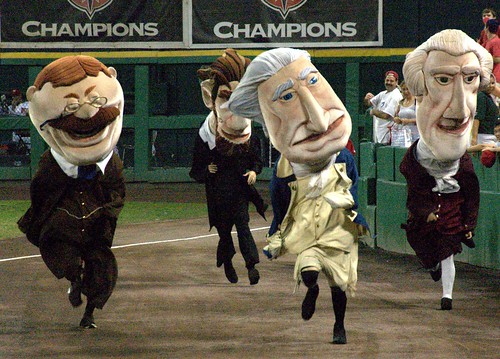
Much like a minor league baseball stunt, to keep the fans entertained between innings, there is a Presidential race. Only this race involves four mascots representing the four presidents on Mount Rushmore.

Every game, George Washington, Thomas Jefferson, Abraham Lincoln and Teddy Roosevelt compete. The race originated as a scoreboard graphic, but has morphed into the "live-action" race pictured above.

There is a running joke that Teddy Roosevelt never wins. He'll often become distracted, or become disqualified for numerous reasons.

For more information about the race, you can read more at wikipedia: http://en.wikipedia.org/wiki/Presidents_Race

By the way, the Phillies are currently winning 6-3 in the 7th.

Read More...

Saturday, October 11, 2008

Washington Burning: The Creation of Our Nation's Capital

In 1791, in a quaint Philadelphia town house near Sixth and Market Streets, just a short walk from Chestnut Street where his congress would meet, President George Washington approved a plan to move the nation's capital to an undeveloped plain of undulating hills along the Potomac River. Coincidentally, this new plan would place the president's house and Congress over a mile apart. But with the hiring of Peter Charles L'Enfant, that mile and the rest of the 10-square mile plot would become one of the grandest cities this nation will ever see.

I had never thought much about Washington, D.C. I understand its importance. I've stood on Pennsylvania Avenue, in awe of the White House. I've seen the reflection pool and pictured Martin Luther King proudly shouting "I have a dream!". I've seen the Washington monument and thought of "the republic for which it stands". But I had never given thought to the blank canvas that existed on the banks of the Potomac River a little more than 200 years ago and the planning and work that had gone into creating it. Until now.

Washington Burning by Les Standiford, is a book that has made me appreciate our nation's capital more than ever.

What starts out as a story of the building of our capital city becomes an excellent account of history and the roller-coaster life of the cities original designer, P. Charles L'Enfant.

L'Enfant is a very curious character, one who in my opinion deserves way more recognition in American history than he's received. His visions of grandeur, as expensive as they may be, eventually do come to fruition under the tutelage of other designers. L'Enfant's life seems to parallel the ebb and flow of the making of the city, it's demise during the War of 1812 and it's eventual resurgence.

Standiford has a knack for helping the reader to visualize the correspondence between the rotating architects commissioned to finish the job L'Enfant started, and each of the founding fathers who had a say in the city's planning. His ability to describe war movements and the "what if's" in history compare to Michael Shaara's account of Gettysburg in The Killer Angels.

Each chapter is a small vignette of the history of the making of Washington D.C.. Standiford often goes into great detail, demonstrating his ability to research and describe only what is most important. Washington Burning brings out great stories of George Washington, John Adams, Alexander Hamilton, Thomas Jefferson and James & Dolly Madison. The intimacy of these stories and those of some lesser known characters make Washington Burning a great read.

For more information about the author Les Standiford, you can visit his website at
http://www.les-standiford.com/, or read his blog.

Here is a link to the book on Amazon.com if you're interested in purchasing it.


Notes:

In doing some of my own research on the topic I came across this website, which is a well written account Washington's history by Bob Arnebeck: http://www.geocities.com/bobarnebeck/introduction.html

And if you're super curious, like me, and you're wondering how Washington D.C. got it's name. Then you can check out this link by Arnebeck who describes the christening well: http://www.geocities.com/bobarnebeck/name.html

Read More...

Friday, September 26, 2008

Founding Fathers Quote Friday - Liberty

Favorite Founding Father's Quote Day

This is the second installment of a weekly meme called FFQF, or, "Founding Father's Quote Friday" - to read more about what it is you can click here.

This month's theme is Liberty. And today's Founding Father is The Godfather of Founding Fathers, George Washington.

"Liberty, when it begins to take root, is a plant of rapid growth."

This quote from President Washington is taken from a letter he wrote to James Madison on March 2, 1788. The letter was written to Madison on the eve of the election of officials from Massachusetts, who were to vote on the ratification of the Constitution.

It was during this time in 1787 and 1788, that Madison, along with Alexander Hamilton and John Jay wrote the famed Federalist Papers. Most of the essays were published in between October 1787 and August 1788. So this letter falls right in the middle of it all.

In reading this quote and knowing it's context I get a sense that Washington was confident in the ratification of the Constitution. Almost reassuring Madison, who was the chief architect of the document, as it was based on his Constitution of Virginia, that his hard work would not go for naught.

By June 21, 1788, the Constitution had been ratified by nine states and it soon went into effect. The rest, as they say... is history.

The letter can be read in its entirety below.

Mount Vernon, March 2, 1788

Sir:

The decision of Massachusetts, notwithstanding its concomitants, is a severe stroke to the opponents of the proposed Constitution in this State; and with the favorable determination of the States which have gone before, and such as are likely to follow after, will have a powerful operation on the Minds of Men who are not actuated more by disappointment, passion and resentment, than they are by moderation, prudence and candor. Of the first description however, it is to be lamented that there are so many; and among them, some who would hazard every thing rather than their opposition should fail, or have the sagacity of their prognostications impeached by an issue contrary to their predictions.

The determination you have come to, will give pleasure to your friends. From those in your County you will learn with more certainty than from me, the expediency of your attending the election in it. With some, to have differed in sentiment, is to have passed the Rubicon of their friendship, altho’ you should go no further. With others (for the honor of humanity) I hope there is more liberality; but the consciousness of having discharged that duty which we owe to our Country, is superior to all other considerations, will place small matters in a secondary point of view.

His Most Ch—n M—y speaks, and acts in a style not very pleasing to republican ears or to republican forms; nor do I think this language is altogether so to the temper of his own subjects at this day. Liberty, when it begins to take root, is a plant of rapid growth. The checks he endeavors to give it, however warrantable by ancient usage, will more than probably, kindle a flame, which may not be easily extinguished; tho’ for a while it may be smothered by the Armies at his command, and the Nobility in his interest. When the people are oppressed with Taxes, and have cause to suspect that there has been a is application of their money, the language of despotism is but illy brooked. This, and the mortification which the pride of the Nation has sustained in the affairs of Holland (if one may judge from appearances) may be productive of events which prudence will not mention.

To-morrow, the Elections for delegates to the Convention of this State commences; and as they will tread close upon the heels of each other this month becomes interesting and important. With the most friendly sentiments and affectionate regard &c.

Read More...

Tuesday, August 19, 2008

Dr. Benjamin Rush: An Underrated Signer

 George Washington, Thomas Jefferson, John Adams, Thomas Paine and Lewis and Clark. Each of these men owe a great deal of their success to a lesser known man named Benjamin Rush.

Each and every one of the aforementioned characters was aided in one way shape or form by Dr. Benjamin Rush.

In 1813, at the time of his death, Dr. Benjamin Rush was arguably one of America’s three most notable men, George Washington and Ben Franklin being the others. Rush was a signer of the Declaration of Independence, he served under 3 presidents, founded five colleges, and trained thousandas of medical students.

In June 1776, he was appointed to represent Philadelphia at the Continental Congress. He later became the physician-general of the Continental Army, where he campaigned for the removal of George Washington as the Army General, after a series of defeats. He later expressed regret for his actions. Washington and Rush were not the best of friends...

Read more about the conversations between George Washington and Benjamin Rush.

Rush is most famous, however, for helping to reconcile the friendship of Thomas Jefferson and John Adams.

Dr. Rush did not align himself with either party. His ecumenical approach to politics allowed him to foster relationships with men from both parties, and kept him employed under three different Presidents of varying political beliefs. Thus, Rush was friendly with both Jefferson and Adams.

Rush's efforts would eventually help to reconcile differences between the two great minds. Our good friend Hercules Mulligan of the Foundation Forum puts it best on his blog entry: The Dream of Benjamin Rush. Why reinvent the wheel? Read his post, after finishing mine of course.

Rush also played an important role in the creation of one of America's most influential and inspiring documents, the pro-independence Common Sense. Rush consulted Thomas Paine on the writing of the document.

Thomas Jefferson sent Meriwether Lewis to Philadelphia to meet with Dr. Rush with the hope of preparing them for their great exploration. Rush taught Lewis about many of the illnesses he would encounter in the frontier as well as a crash course on bloodletting. Rush provided the expedition crew with a medical kit which included laxatives that contained mercury. As it turns out, these laxatives came in very handy as the lack of clean water and the diet heavy in meat caused the corps to use the pills often.

Incidentally, the large traces of mercury in the crews' feces have allowed scientists and archaeologists to trace more closely the actual route blazed by Lewis and Clark.

All this said, I'm proud to be a founding teacher of a brand new high school in the Philadelphia School District named none other than: The Arts Academy @ Benjamin Rush.

I'm very fortunate to be a part of this once in a lifetime opportunity of building a high school from the ground up... from the mission statement to graduation. I can't wait to get started.

If anyone out there has any experience in a brand new school... and I mean brand new, first time opened... please share some pointers.

For more information about Benjamin Rush, visit:
Benjamin Rush: Patriot and Physician
http://en.wikipedia.org/wiki/Benjamin_Rush

You shouldn't have any trouble finding information about Rush. Rush wrote over 2,000 pages of published letters and essays, in addition to hundreds of unpublished papers. His works are scattered around the world and can be found in both public and private collections.
Here are just a few of his selected writings.

Read More...

Thursday, April 10, 2008

Survey Results: You Have a Time Machine. Who would you like to meet?

Teddy Roosevelt wins the first USHistorySite surveyThe results are in from the first USHistorySite Survey... after 50 votes, Teddy Roosevelt is our winner taking 44% of the vote.


You Have a Time Machine: Who Would You Like to Meet?
John Adams - 10% (5 votes)
Teddy Roosevelt - 44% (22 votes)
Abraham Lincoln15 - 30% (15 votes)
George Washington8 - 16% (8 votes)

It's not a surprise. Teddy Roosevelt is like able. He's a guy's guy. Of the 4 listed, he's probably the one I'd most like to have a beer with. Not that I wouldn't want to meet all of them, it's just that Teddy seems to be rowdy ol' chap, who could probably spin a good yarn, and put 'em down with the best of 'em.

Lincoln, and his self-deprecating stories, and his sense of humor, is something I'd enjoy too. But Lincoln, to me, is more of a guy who would have you over his house for dinner and then tell stories after retiring to the living room. That would be fun too.

Washington is still kind of enigma to me. I know that he liked to associate in high circles, and then he'd rarely if ever hang out with someone of a lower cloth. He was an American aristocrat. I wish I knew more about Washington. He'll probably be my next focus of study, as I've always felt that he wasn't much of a personality, but one who lead with his presence. I silent, thoughtful leader.

Adams is a hard worker. His Boston brethren, to this day, still follow him and his 'blue collar' work ethic. If you're on his good side, he's a great friend. He stands up for what he believes, but is a little awkward in social situations. He's known for being 'obnoxious and disliked'.

Congratulations to Teddy Roosevelt for being the first winner in the USHistorySite Survey. Thank you to all that participated.

The lines are now open for suggestions for the next survey.

Read More...

Tuesday, March 25, 2008

John Adams Miniseries- Part 2 - Independence

Just some quick thoughts on Part 2 of the HBO miniseries. HBO did run this back to back with Part 1 last week, luring people with the excitement of 2 full hours of drama.

Part 2, entitled Independence, picks up at the First Continental Congress. I'm paralleling my reading of McCullough's John Adams with the mini-series and notice that HBO has decided to take what Adams wrote in his journals and use it in the dialog in Adams' conversations. It's a much better strategy than that of a voice over, which to me can be a distraction.

Once again, many great events in American history are referenced and not highlighted, and for good reason. It must be noted that these are the trials and tribulations of John Adams and not an overview of the Revolution, and thus Lexington and Concord warrants only a mention in passing. So if you're wondering when you're going to see George Washington at Valley Forge, you won't.. but pay attention, it is alluded to.

Ben Franklin, John Adams and Thomas Jefferson reading the Declaration of IndependenceAnother observation I found curious was the editing of Jefferson's version of the Declaration of Independence. In the past, I've seen it as being picked apart by many of the Delegates in front of the entire Congress. Director, Tom Hooper, has decided that it was edited in private by Adams, Ben Franklin and Jefferson at Jefferson's apartment. Like the image to the left. This idea would fit to be more realistic as it was a document that had not yet been presented in any way, shape or form to the Congress, and it would seem that it should be perfected before doing so.

The final vote for Independence, which required a unanimous decision was very well done, though not as dramatic as the one I'm more familiar with in the musical 1776. But on that note, the reading of the Declaration of Independence is effectively passionate, as it starts with John Hancock, President of the Congress, and moves to Adams' daughter reading amongst Abigail and her siblings, and then to an assembly in front of the Pennsylvania State House (now known as Independence Hall).

The voting and the reading of the Declaration of Independence can be effective if shown in class. Especially if followed with 'The Price They Paid', which is a reading about what happened to the 56 delegates after signing the Declaration. I also challenged my students to take it even a step further to see if they could prove if all the stories about the Delegates were true. They're not all true... See for yourself.

Read More...

Tuesday, February 19, 2008

An Officer and a President: The Military Service of Our Presidents

One of our President's seven main duties is that of Commander in Chief of the U.S. Armed Forces. Essentially the be-all-end-all of every major military decision. From the signing peace treaties with Britain in the late 1700s to the decision to remain in Iraq in 2008, the President is the highest military authority.

This being said, serving in the military is not a pre-requisite to become President, although more than half of our Presidents have done so.

In these times of change, Republican front-runner, John McCain's military background is being seen by some as a competitive advantage. And if elected it could very well impact his decision making. A recent article on McCain in Newsweek highlighted this fact and also took a closer look at six presidents who's military service have had a particular impact on them. According to historian Michael Beschloss)

George Washington
Top Military Rank: General
Active Service: American Revolutionary War, French and Indian War
Branch: Virginia Militia, Continental Army

After successfully winning the Revolutionary War, Washington knew Britain still posed a serious threat, and thus signed an unpopular treaty with Britain protecting the United States from British invasion.

Andrew Jackson
Top Military Rank: Major General
Active Service: American Revolutionary War, War of 1812, Creek War, First Seminole War
Branch: Continental Army, United States Army

Known to many as the guy on the $20 dollar bill, Andrew Jackson learned a great lesson from standing up against and defeating the monstrous British Army. It gave him the courage to take on other big foes like the U.S. Bank. Although it also gave him the confidence to stomp out the innocent Cherokees and force them to move West, killing over 4,000 Cherokees on the Trail of Tears.

Theodore Roosevelt
Top Military Rank: Colonel
Active Service: Spanish-American War
Branch: United States Army

Victory in the Spanish-American War made Roosevelt a national hero. He snowballed this fame into a successful political career, catapulting him to President. Roosevelt definitely used his personality to his advantage and for that is one of our most popular Presidents. His victory in the war, giving the US control over Puerto Rico, Guam and the Philippines also set the stage for American Imperialism impacting much more than just Teddy's Presidency.

Roosevelt was also the only U.S. President to receive the Medal of Honor (awarded posthumously in 2001).

Dwight D. Eisenhower
Top Military Rank: General
Active Service: Stateside service during World War I, Supreme Allied Commander in Europe during World War II, military career lasted from 1915 to 1952.
Branch: United States Army


Like Roosevelt, it was Eisenhower's military prowess that sprung him to Presidency. But it was Ike's time in Europe where he learned that Presidents usually inflated the national budget. When pressured by the Pentagon to increase the budget for the defense war chest, Eisenhower refused and kept a well balanced budget.

John F. Kennedy
Top Military Rank: Lieutenant
Active Service: World War II
Branch: United States Navy

Kennedy's service in World War II gave him the critical thinking skills to realize how one problem could cause another and another. This undoubtedly gave him the decision making skills and the mind-set to handle the Cuban Missile Crisis as calmly and as successfully as he did.

George H.W. Bush
Top Military Rank: Lieutenant
Active Service: World War II
Branch: US Navy Reserve


Big Bush was a pilot. His aviator experience made him knowledgeable about the risks associated with war (He was shot down and lost two of his crewmen). Some believe this encouraged him to support the Powell Doctrine, which states that a list of questions all have to be answered affirmatively before military action can be taken by the United States.

Though there are only six presidents highlighted in the McCain article, there are several other's who's time in the military impacted their presidency. I've taken the time to do some of my own research to find them.


Ulysses S. Grant
Top Military Rank: General
Active Service: Mexican War, Civil War
Branch: US Army

We all know Grant received world-wide fame for leading the Union Army to victory in the Civil War. But, Grant was fighting a war of attrition. Compared to General Lee, he had a larger, better equipped, and better fed army and wasn't afraid to watch men die. That said, he'd win his battles based on sheer numbers. This doesn't take away his unbelievable strategy at Vicksburg, but it did effect his presidency.

Experts, traditionally view Grant as a President in the bottom quadrant of US Presidents, mostly because of his tolerance of corruption. Grant would often tolerate financial and political corruption among top aids, seemingly unaware of the consequences to those that were being cheated. Though an honest man, Grant appears to have no heart when it comes to the well-being of others.

Jimmy Carter
Top Military Rank: Lieutenant
Active Service: World War II
Branch: US Naval Academy
Carter, had originally planned to make the Navy his career making Chief of Naval Operations his ultimate goal and believed that submarine duty was the fastest route to get there. Carter thought nuclear power would be increasing in submarines and he wanted to be where the growth was.
Carter did post-graduate work, studying nuclear physics and reactor technology for several months in 1953. This followed Carter's first-hand experience as part of a group of American and Canadian servicemen who took part in cleaning up after a nuclear meltdown at Canada's Chalk River Laboratories reactor.

His studies and experience helped Carter to understand the power of nuclear technology, knowing that the same science that could keep a submarine submerged underwater for months at a time, could undoubtedly do a lot of damage when used in weaponry. Thus Carter's knowledge of nuclear physics led him to the Strategic Arms Limitations Talks (SALT), which was a treaty aimed at reducing the number of nuclear arms produced and maintained by both the United States and the Soviet Union.

Richard M. Nixon
Top Military Rank: Commander
Active Service: World War II
Branch: US Navy Reserve

While working in the supply corps on several islands in the South Pacific, Nixon who is "not a crook", banked a large sum of money, which in turn helped him finance his first campaign for congress.
Harry S. Truman
Top Military Rank: Colonel
Active Service: World War I
Branch: US Navy Army/Army Reserve

Truman's eye-sight was terrible, and he reportedly secretly memorized the eye chart to pass the test to be enlisted in the Missouri National Guard, where he served from 1905-1911. He rejoined the Guard during the onset of WWI. The War brought out Truman's leadership qualities where he quickly rose to the rank of Colonel. This made possible his political career in Missouri and in turn to the Presidency.
Incidentally, between Truman and Teddy Roosevelt, there were no presidents to serve in the military. This was a run of 6 presidents, and 36 years between them. Taft, Wilson, Harding, Coolidge, Hoover, and finally Franklin Roosevelt, were the 6 in succession not to serve any military duty.

On the opposite side, Bill Clinton, was the first not to serve since FDR. This was a run of 9 presidents and 40 years between them. And although military experience can be very important for the character of the president, it is not, and shall never be a pre-requisite.

Read More...

Sunday, February 17, 2008

A Brief History of President's Day -

George Washington and Abraham Lincoln Presidents Day imageBecause I'm curious and I like to share the fruits of my curious mind, I once again present to you the true history of another American Holiday. This time, it is Presidents' Day's turn.

In 1796, during the last full year of Washington's presidency the United States decided to honor their great president by celebrating his birthday. Washington was born on February 22, 1732. Though according to the old style calendars which predate the mid-18th century his birthday falls on February 11. I know it's confusing.

By the early 1800s Washington's Birthday had become an established, though not official, national holiday. Americans would honor Washington by throwing lavish Balls and receptions attended by prominent socialites and public figures. The common man would celebrate, as we American's still do, by gathering in public houses and taverns to honor Washington as another excuse to drink.

Then another well-respected February born president came onto the scene. Abraham Lincoln, whose birthday falls on the 12th of February, was formally honored on his birthday in 1865, one year after his assassination. To commemorate his death, both houses of Congress gathered for a memorial address, on the day of his birth.

Unfortunately for Lincoln, his birthday did not become a legitimate national holiday like Washington's did, but it did become a legal holiday in several states.

Washington's Birthday became an official holiday in 1880, becoming the first federal holiday to honor an American citizen. It was to be celebrated on February 22.

Don't click away yet... there's more.

In 1968, legislation was put in place to simplify yearly calendars and give federal employees some fixed 3-day weekends. The act started in 1971 shifting the observation of Washington's Birthday to the third Monday in February instead of on the 22nd. And although this holiday is still officially known as Washington's Birthday, it has become popularly known as Presidents' Day. This now makes the third Monday in February a day for honoring both Washington and Lincoln. Though I'm pretty sure it's okay to honor other presidents as well.

And in true American fashion, Presidents' Day is also synonymous with sales and shopping. Do you think George and Abe mind people honoring them by buying discounted appliances?

PS - Though most put the possessive apostrophe for President's Day after the 'T' (like I did here and in in my title for search engine optimization reasons), it is incorrect. This spelling indicates a day belonging to one President, while putting the apostrophe after the 'S', in spelling Presidents' Day, indicates a day belonging to more than one President.

Read More...

Wednesday, December 12, 2007

Happy Birthday John Jay!

John Jay, the least recognized of the three authors of the Federalist Papers, who was also elected by George Washington as our our Nation's first Supreme Court Justice, was born on this date, December 12, 1745.


To me this wouldn't be news if it were not for the coincidence of one of his more famous causes and another significant historical event which shares this same day.

Let's set the scene with The Federalist Papers.

Written under the pen-name of "Plubius" John Jay is said to have authored 4 of the 85 articles written in support of the ratification of the Constitution approved by the Continental Convention on September 17, 1787. The first of these anonymous articles appeared in the New York Independent Journal on October 27, 1787.

At the time, a federalist was someone who supported "big government", while an anti-federalist believed the power should remain with the people. John Jay, along with Alexander Hamilton and James Madison were staunch proponents of the new Constitution.

They believed a centralized government was essential to expand the United States both commercially and geographically. Only a strong national government, they argued, could effectively negotiate with foreign countries, ensure free trade between states, and create a stable currency.

Thomas Jefferson, probably the most famous anti-federalist believed that big government would take too much power away from the people, which after all was the true meaning of democracy. It was these beliefs that laid the groundwork for our two party system.

Soon, steps were being taken to make sure that John Jay and Alexander Hamilton would win this battle.

It was December 12, 1787, John Jay's 42nd birthday when Pennsylvania became the second state to ratify the Constitution, 4 days after Delaware ratified the same document. Happy Birthday John Jay. I'm sure a pint or two was imbibed in celebration of Pennsylvania's ratification.

On a related note:
Despite both being selected to be in George Washington's cabinet, Hamilton and Jefferson would have to agree to disagree. Hamilton took the seat of Secretary of the Treasury setting a plan for a capitalist United States based on big government and big business. On the other hand Jefferson was chosen as Secretary of State and asked to deal with foreign powers. His first came during the French Revolution when he and Washington disagreed on how to handle the situation.

Read More...