


Don't know what it is about these lists... but people love them.
According to the Online Education Database, these are the Top 50 Books. They've inspired, provoked thought and caused controversy.
Enjoy....
http://oedb.org/library/features/50_books_that_changed_the_world
Wednesday, June 16, 2010
50 Books That Changed the World


Saturday, June 12, 2010
National History Day
National History Day projects are being judged in the final rounds this week... For any teacher who's ever taken on this endeavor, you understand the work and excitement that goes along with the NHD.
Below is text received from National History Day - they asked me to share it with my readers:
"During the week-long national contest from June 13-17, 2010, thousands of middle and high school students, educators, and parents come together to compete for scholarships and prizes, with finalists from 49 states and abroad. Students will compete for gold, silver and bronze national awards, as well as college scholarships.
More than 300 judges (including historians and educators from secondary and higher education institutions, museums, archives, and government agencies) will evaluate the students’ award-winning work throughout the week. Noted filmmaker, Ken Burns, and author and historian, Cokie Roberts, serve on the honorary cabinet for NHD; and A&E Television Networks’ History Channel serves as a program partner.
A media event on Monday morning will feature a rare original printing of the Declaration of Independence.– one of 25 known to exist in the world – was the original printed on July 4, 1776, and is now owned by Hollywood producer and philanthropist, Norman Lear, who has lent the document to commemorate NHD’s students. At NHD, this Declaration of Independence will be on its first ever visit to Maryland. Invited elected officials will unveil the Declaration of Independence and welcome the outstanding students and teachers at a media event to kick off the week, followed by projects and displays throughout the week. Invited speakers include members of Congress representing Maryland, including Representatives Chris Van Hollen, Donna Edwards, and Paul Sarbanes, and Senators Barbara Mikulski and Benjamin Cardin.
Competing with documentaries, live performances, and original websites, the students – ranging in age from 11 to 18 – created innovative projects this year that include:
• “Vaccination: The Musical” – a live musical theater performance about the history and impact of vaccination on global health
• “Google: Impact and Change” – a live performance that illustrates Google’s impact on a generation
• “Off the Bench and Onto the Field: How Title IX Changed Girls\' Athletics and Education” – a theatrical performance that portrays the 70-year fight for equality in sports
• “Al Qaeda and the Internet: A New Age in Terror” – a documentary that discusses and analyzes terrorists’ contemporary use of the Web
One notable past NHD project included three students from Chicago who helped provide new evidence that re-opened the Mississippi Burning case and brought the killer finally to justice (http://www.
Please let me know if you’d like more information on NHD or the events taking place throughout the week. I’d also be happy to connect you to any of the teachers, students, or program directors in the meantime or at the event week. Video and photos of all participating students and educators will be made available all week, and you can keep up with NHD on Twitter (@NationalHistory), Facebook (http://www.facebook.com/
Monday, May 31, 2010
America: The Story of Us
With my busy life (redesigning/renovating our basement, and having a fantastic 10 month old son), I was finally able to catch up to my DVR and watch some of one episode of America: The Story of Us.
The episode I caught was during World War II, and our jump into mass war production. This was fitting considering it was Memorial Day weekend. To say the least, I was impressed. It's a great perspective of the war that is often times overlooked. It is not uncommon to find films of this nature caught up in the minutiae of war instead of the looking at the big picture. I was impressed to the point where I'd like to pre-order the videos to add to my teaching library. As a teacher, I know that kids would rather see the big picture so they can easily make connections to knowledge they already hold.
You can pre-order your copy today too at Amazon.com... America: The Story of Us (Three-Disc Set)
Below is a short preview of one of the many vignettes that 'America:...' offers. You can view more at Fancast.com
Sunday, May 16, 2010
History Top 100 - History Websites
Here's a collection of a bunch of interesting history websites. If you've got a history site, be sure to add your site. It's quick and easy. The owner of the site is very quick to reply to any issues.
Top 100 History Websites

Saturday, May 08, 2010
Q&A with Author Kenneth C. Davis; A Nation Rising, Untold Stories of Flawed Founders, Fallen Heroes, and Forgotten Fighters from America's Hidden History
Kenneth C. Davis is the author of the book, "A Nation Rising; Untold Tales of Flawed Founders, Fallen Heroes, and Forgotten Fighters from America’s Hidden History"
Below is a short interview
“When You Don’t Know Much, Ask a Question: A Q -and- A with Bestselling Historian Kenneth C. Davis”
Since I began my career as a writer more than 25 years ago, I have embraced the basic belief that there are no bad questions—only bad answers. Whenever I write a new book, give a speech, talk to teachers, students, librarians or radio show audiences, I try to invite questions and tackle them as best I can, while encouraging a spirit of curiosity in adults and children alike.
Here are a few questions that I am often asked —as well as some new ones about my current work.
Q. You didn’t finish college and you're not a trained historian or academic. How did you come to write history books?
A. Years ago, while working as a freelance journalist and book reviewer, I was casting about for a book project when my wife said to me, “You love American history. Why don’t you write about it?” That’s how I got started on Don’t Know Much About History more than 20 years ago. To my surprise the book went onto the New York Times bestseller list, stayed there 35 consecutive weeks and eventually sold over 1.5-million copies. Don’t Know Much About History gave rise to a series of “Don’t Know Much About” books for adults and children. More recently, I wrote America’s Hidden History, and my new book, A Nation Rising.
But my love of history is much older –it goes back at least as far as third grade, when I wrote a book about the U.S. presidents with colored markers on construction paper. (Thanks to my mother, I still have it!) As a child, on family camping trips to places like Gettysburg and Fort Ticonderoga, I learned that history isn’t about marble heroes in textbooks—it happens to real people in real places. And that the “villains” like Aaron Burr or Benedict Arnold can sometimes be heroic too.
All I’ve done in my books is to share my passion and curiosity and try to replace that “black hole” of dates and battles called “American History” with some true stories of remarkable, real people, told in an entertaining style.
Q. How do you respond to critics who say you are tearing down our history and our heroes with a “negative” approach?
A. I don’t equate “negative” with “accurate.” People are ignorant of history because they are bored. They are bored because we have created a tidy but false narrative that is more like a bedtime story than real, live history. Our “heroes,” like Andrew Jackson in this new book, were capable of reprehensible things –like cutting off the noses of dead Indians to count casualties. We can put those truths into the context of the times, but we cannot ignore them. And sometimes we can find new “heroes” whose names we didn’t know –like William Weatherford, an American “Braveheart” who fought for his people’s land and freedom. It’s all part of the Hidden History. It’s not always pretty, but it sure is interesting.
Q. What is your new book, A NATION RISING, all about?
A. This book describes what happened between 1776 and the Civil War –you know, those famous “four score and seven years ago.” More precisely, I set out to tell the story of an extraordinary half-century in which America went “from sea to shining sea.” But I’ve done it through the lens of six stories that your schoolbooks probably ignored. They are stories of courage, corruption, conquest, and conspiracy –not the tidy tales of “rugged individual” pioneers heading west and happy immigrants coming to America, mixing into the “melting pot” and fulfilling the dream.
Q. Of all the things that happened between 1800 and 1850, how did you choose the six stories in this book?
A. I often head down one path of research only to discover all sorts of people and events that have been overlooked –or deliberately erased—by our history books. Aaron Burr is a good example. I learned that as a 19-year-old, he served in the Revolution with Benedict Arnold and that remarkable coincidence fascinated me. Then I went on to find that this extraordinary character, who was reduced to a murderous scoundrel, was actually more complex and quite noble –he was a war hero, an early abolitionist and an advocate of the vote for women. Or in looking into Andrew Jackson and the Battle of New Orleans, I found another story in the Fort Mims Massacre in Alabama that led to Jackson’s brutal first war with Native Americans, who called him “Sharp Knife.” I had never heard of Fort Mims, but it was the deadliest frontier massacre in American history, a 19th-century “9/11” moment. But most of us never heard the name “Fort Mims.”
Each of these stories involves this incredible expansion of America –what the textbooks called “Manifest Destiny.” But they left out the sordid details and the human cost of that lofty goal: the ethnic cleansing in our own past; the violent fights over religion; the vicious attacks on immigrants. And these stories are not only fascinating; they are important and obviously timely. We are still fighting over immigrants and religion in America.
Q. You've sold 4.5-million books. But your name isn't as well known as other historians. Why is that?
A. I may be the “Rodney Dangerfield of American History “—”I don’t get no respect.” No, seriously, my satisfaction doesn't come from being famous but rather from hearing a parent who says that my books got their kids hooked on history. And there’s always the student who gratefully tells me, “Your book got me through my AP History exam.” But the best compliment is when a teacher comments, “Your books made me want to teach History.” I consider that a good day’s work!
© 2010 Kenneth C. Davis

Thursday, May 06, 2010
On This Day in US History: The Sinking of the Lusitania
The following information is courtesy of The Library of Congress (http://rs6.loc.gov/ammem/today/may07.html):
"On May 7, 1915, the German U-20 (submarine) sank the British ocean liner Lusitania. Approximately 1,200 civilians died; more than 100 were U.S. citizens.
In reply to President Woodrow Wilson's protest, Germany justified the attack on grounds that the British government intended to arm merchant ships. Prior to the Lusitania's departure, the German government had warned that ships entering the war zone could be fired upon.
The Lusitania carried both passengers and ammunition that had been manufactured in the United States. The incident illustrated the difficulty of maintaining American neutrality. Appalled at Wilson's willingness to criticize Germany while ignoring British transgressions, Secretary of State William Jennings Bryan resigned.
The sinking of the Lusitania also highlighted the changing nature of war. Traditional rules of naval engagement mandated warning commercial vessels before firing upon them. However, surfacing to do so would place a U-boat in grave danger of destruction.
Public outrage over the loss of American civilian life hastened the U.S. entry into World War I. Although the cargo list of the Lusitania stated that she carried approximately 170 tons of munitions and war material, this information was not revealed to the public at the time. "
The very fact that the information was not revealed to the public is cause for debate. This "white lie" allowed the United States to rid themselves of any wrongdoing and pin everything on the German. Propaganda posters of the Kaiser would soon follow.

Monday, May 03, 2010
The Correspondence of John Cotton Junior
In today's world of email, cell phones and electronic media it is not uncommon for a private correspondence to reach the masses. Though it may happen quite a bit by error, there are times when the viral nature of one's "private" correspondence was released on purpose.
John Cotton Jr. (1639-1699) was born to one of New England's most famous clergymen. By the age of 22 he was already the pastor of a church in Wethersfield, Connecticut and trying to put out the fire of a sexual scandal. Already excommunicated from the First Church in Boston, for sinfulness with a woman other than his wife, Cotton diligently contested the charges brought against him.
Jobless, embarrassed and disgraced, Cotton moved his family from Connecticut to Martha's Vineyard, where he became a missionary to the Indians. This move allowed him back into the good graces of the Church and soon accepted a job to the church in Plymouth. For nearly 30 years he avoided scandal, until Church politics got the best of him once again.
What makes John Cotton Juniors story so fascinating is that his letters and writings were written in an era when it was widely accepted that his correspondence would reach far more than the intended recipient. It is because of this that many letters addressed to him and written by him often read as newsletters and political propaganda. These writings help to document some of the most dramatic happenings of the late 17th century in New England and the American colonies.
Thursday, April 15, 2010
The Great Virginia Triumvirate; George Washington, Thomas Jefferson & James Madison
I love the University of Virginia Press. And I think they love me. They send me the best books. And what's great about the University of Virginia Press is the fact that their books are Virginia-centric. This means, you'll find a lot of books on Washington, Jefferson, Madison, et. al.
The most recent of these books is entitled, The Great Virginia Triumvirate: George Washington, Thomas Jefferson & James Madison, In the Eyes of Their Contemporaries.
With the help of these three men, Virginia played an important role in the fight for independence. And as one of the largest and wealthiest of the colonies, they played an equally important role in helping to set up the new republic. This is demonstrated with the number of Virginians who played key roles in guiding the fledgling nation.
Washington as Commander in Chief and Army General, Thomas Jefferson as a statesman and scholar and James Madison as the "Father of Our Constitution".
Author John Kaminski, who's Founders on the Founders is an excellent glimpse into the lives of our forefathers through personal quotes from journals and writings. His knack for using candid dialogue and letters to bring personality to the founders is once again brought back in The Great Virginia Triumvirate.
This is a series of biographical portraits that bring these three men to life through the words of these three Virginians themselves.
Take for example the idea that Jefferson once told John Adams that he had not written about his life or a history of his time because he found his correspondence to be more direct and honest. This in turn would provide a more accurate history of the time.
Taken from letters, speeches, diaries and memoirs, the quotations and vignettes bring to life the personalities behind the public personae of these great men.
Wednesday, April 07, 2010
US Presidents Race
Those that have been reading this blog know that I'm a baseball fan. Much more than a baseball fan, I've been a die-hard Phillies' fan my entire life. As a kid I had some very lean years in the mid-80s. Lately, as you may well know, the Phillies have made up for many of those last place finishes. The city has really embraced this team.
Tonight the Phillies are playing the Washington Nationals.
I think it's worth mentioning that the Nationals have a pretty cool tradition at their home games that has great historical significance.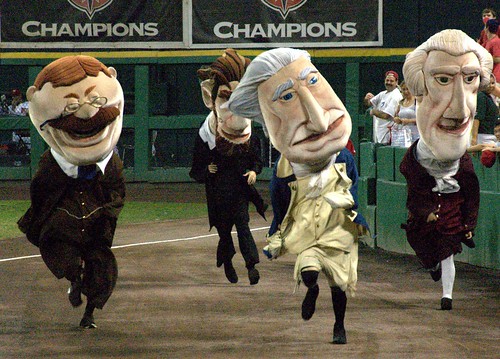
Much like a minor league baseball stunt, to keep the fans entertained between innings, there is a Presidential race. Only this race involves four mascots representing the four presidents on Mount Rushmore.
Every game, George Washington, Thomas Jefferson, Abraham Lincoln and Teddy Roosevelt compete. The race originated as a scoreboard graphic, but has morphed into the "live-action" race pictured above.
There is a running joke that Teddy Roosevelt never wins. He'll often become distracted, or become disqualified for numerous reasons.
For more information about the race, you can read more at wikipedia: http://en.wikipedia.org/wiki/Presidents_Race
By the way, the Phillies are currently winning 6-3 in the 7th.
Monday, April 05, 2010
Top 25 Websites for Teaching and Learning
The American Association of School Librarians has compiled a list of some very useful websites.
The "Top 25" sites foster the qualities of innovation, creativity, active participation, and collaboration. All of the websites are free, Web-based sites that are user friendly and encourage a community of learners to explore and discover.
Top 25 Websites for Teaching and Learning
I've used several of these.... I can speak for the power of VoiceThread, Wordle and Wikispaces.
Another great site not to make the list is Wallwisher.
Thursday, April 01, 2010
US History in Video - Free Access Through April
No agenda here... just a link to some Free US History videos.
With over 1,000 hours and 4,000 titles, American History in Video is the largest and richest collection of video available online for the study of American history.
Using commercial and governmental newsreels, archival and public footage and important documentaries, it's a great collection that allows students and researchers to analyze historical events.
And the best part is that access to all of this is FREE until April 30.
So gather what you can and plan your lesson plans accordingly as not to miss out on this opportunity. It's always good for kids to see news casts and footage from actual events, instead of having to read about it.
http://ahivfree.alexanderstreet.com/
Tuesday, March 30, 2010
100 Online Documentaries for Presidential History
Once again, in an effort to create more back links to their site to increase page rankings in the search engines, the wonderful team at online universities dot com has put together a cool list for us history buffs.
This one, is a list of the documentaries that have focused on presidents and their administration. Our commanders-in-chief are often the subject of documentaries and films, and now you've got many of them all in one place.
Here's the link: 100 Excellent Online Documentaries for Presidential History Buffs
Tuesday, March 16, 2010
The Pacific: HBO Miniseries - For Free!
About 6 weeks ago my wife and I went to a friend's house for dinner. Knowing I'm a history teacher and looking for something to chat about, our friend Tom asked me if I was excited for The Pacific. Not being an avid TV watcher and because I don't have HBO, I had no idea what he was talking about. I made a quick assumption it was a show about the Pacific theater of World War II. He told me he was looking forward to watching it, and that it looked like it was going to be pretty good with Steven Spielberg behind.
I dismissed it, as something I'll probably hear a lot about, and never take the time to rent it from Blockbuster. But the world has changed.
I can watch HBO for free - and thus, can watch The Pacific for free. Just go to HBO.com and register your email address. This is quick and easy, and has some behind the scenes footage you can take a look at.
In the meantime, here are some links to the behind the scenes footage / historical background:
http://www.hbo.com/index.html#/the-pacific/episodes/0/01-part-1/article/historical-background
And the interactive battle maps:
http://www.hbo.com/html/series/the-pacific/battlemaps/
PS - Tom Hanks was on the cover of this week's Time magazine labeled as a History Maker... he's the producer of The Pacific.... (if you recall... he's had a hand in other history projects including, Saving Private Ryan, HBO's John Adams series, Apollo 13, Charlie Wilson's War and one of my all time favorites The Burbs ;) )
Saturday, March 13, 2010
National History Day Needs Your Help
This message is from the National History Day Organization - it's an organization that works with teachers and students in creating projects to present in a variety of formats to a panel of judges. Each year there is a theme where students choose and manage their own projects. It's a good organization. It's losing some funding - and this email below is a call to action to try and keep some of that money coming in to help continue the great things this organization does.
Please read below....
"To our supporters:
We are now at a critical juncture in our efforts for the 2011 congressional budget. We have until Wednesday, March 17th 2010 to contact members of the House. Please, please do what you can to have as many people as possible take those few minutes to call or email their Representative. Keep in mind that congressional funding will benefit every state, especially those state programs that have been suffering in this economy.
CALL TO ACTION
CALL CONGRESS TODAY IN SUPPORT OF NHD FUNDING
FOR FISCAL YEAR 2011
National History Day (NHD) is asking for your help to gain support from members of Congress for a $1 million National History Day appropriation that will help our state programs grow and improve.
Thanks to your efforts, NHD was included in the omnibus bill for FY 2009 & FY 2010 with an appropriation of $500,000! It’s important to note that to be included in a congressional budget for the first time is a major accomplishment. National History Day clearly has the attention of members of Congress, so let’s try and build on our success. Keep in mind that we have programs across the country that could use the extra help of an increased congressional appropriation.
Representative Chris Van Hollen (D-MD) is circulating what is called a “Dear Colleague” letter. The letter is similar to a petition that members of Congress sign in support of funding a program (click here to view the Dear Colleague Letter).
The Dear Colleague asks all members of the House to sign their name to the letter supporting NHD. This letter is addressed to the Chairman and Ranking Member of the House Labor, Health and Human Services and Education Appropriations Subcommittee asking them to support funding NHD in the FY 2011 budget. It is very important to get support from as many members of Congress as soon as possible. This is a very common practice, which is implemented during the appropriations process. It is important that we get as many signatures as we can – as soon as we can (in the next two weeks). The appropriations committee will literally count every signature and the more signatures we have the better chance we will have of getting $1 million in support.
What to do?
Never called your Member of Congress before? Don't worry, it's easy!
When you call your Representative, your call will be answered by a receptionist. Tell him or her that you want to leave a message for the Representative. The receptionist will take down your message.
We need your help. Congress must hear from you today!
NHD NEEDS YOUR HELP TODAY! We have two weeks and it is critical that you pick up the phone today to contact your members of Congress and ask them to sign the NHD Dear Colleague Letter. Our goal is get as many members of Congress to sign this letter in two weeks, which will demonstrate wide-spread support for funding for the NHD program.
When calling a Representative’s office, tell them:
• Your name and the city and state you live in.
• You’re calling today to urge the Representative to sign the Dear Colleague letter, in support of funding for National History Day in the FY 2010 budget. The letter is being circulated by Rep. Van Hollen.
• Why this money would be helpful to the NHD program in your state and district, how it would make an impact to increase the number of participants and improve overall programmatic efforts in the state.
• They can contact Sarah Schenning in Rep. Van Hollen's office at (202) 225-5341 with questions or to sign the letter.
How to Contact a Member of Congress
To find your Member’s contact information, including phone and fax numbers, visit www.house.gov,www.senate.gov, or call the U.S. Capitol Switchboard at (202) 224-3121 and ask for your Representative.
If you have any questions contact Kim Fortney at National History Day at (301) 314-9542."
--
Aja Julian
National History Day
aja@nhd.org
Subscribe to:
Posts (Atom)

 Posts

